110Extension of the Governor’s Power Our sources record some additional powers of the Governor of Awadh in Bahadur Shah’s reign. In early November 1707, Chin Qilich Khan (later Nizamul-Mulk) combined his governorship of Awadh with a number of faujdaris in the province and the faujdari of Jaunpur which (p.60) lay on the borders in Allahabad province in the neighbourhood.3 Later, on 25 January 1708, when he resigned protesting, among other things, for a mansab of 7000/7000, he was persuaded to withdraw his resignation by no less a person than Mun‘im Khan, the wazir. Chin Qilich returned to Awadh with a mansab of 7000/7000 together with all his earlier faujdaris, barring, of course, Jaunpur which still remained in his family as it was given to his uncle, Qilich Muhammad Khan.4
But these additional offices were not meant to strengthen the position of the governor and enable him to encounter the problems of the local administration forcefully. Subadari with more than one faujdari was simply an additional privilege for Chin Qilich Khan, more as a mark of special consideration for his eminence and stature than as an index of any change in the institution of governorship. Chin Qilich’s claim to a high rank of 7000/7000 was also conceded because he was a leader of an important group at the court. Besides, his father, Ghazi-ud-Din Khan Firoz Jang was the governor of Gujarat while a number of his associates were posted in the Deccan where the emperor had yet to meet the challenge of another claimant to the throne, Prince Muhammad Kam Bakhsh. Thus, when Chin Qilich Khan came to Awadh in 1708 he was made to recognize the fact that his special position (p.61) as governor by no means implied additional power in matters related to subadari. The emperor did not approve of his recommendation that one of his friends be appointed to the faujdari of Bahraich. Instead, the post was given to an associate of Zulfiqar Khan, his archrival at the court.5 Also when Chin Qilich Khan disapproved of the compromise that the emperor effected with the Rajputs,6 he lost the faujdaris of Khairabad and Lucknow to the diwan of the province.7 The diwan was again an associate of
Page 3 of 32
111The Changing Position of the Governor
Zulfiqar Khan and thus independent of and a check on Chin Qilich Khan.8 Since these privileges did not suggest any institutional change in the position of the governor, his successors were not allowed to combine these with their governorships of Awadh.9
Chin Qilich Khan perhaps calculated that since a difficult and ‘thorny’ (khardar) province was entrusted to him, his position as governor would (p.62)
(p.63) be, at least, on par with
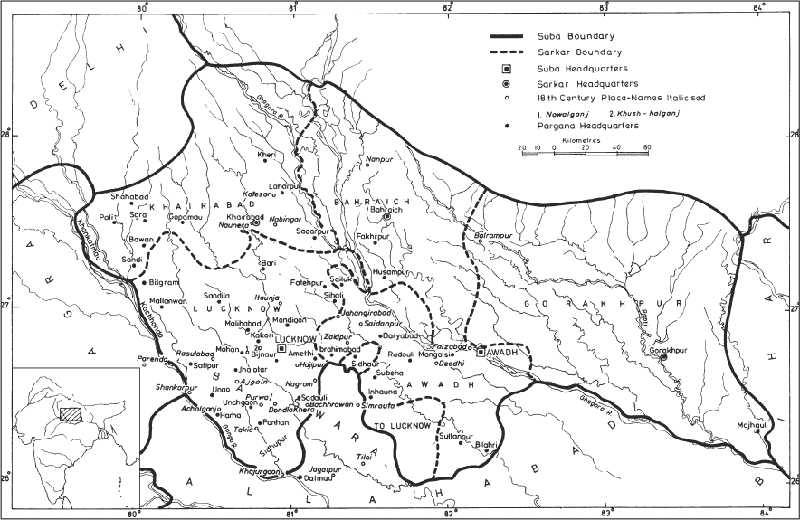
the powers of Zulfiqar Khan in the Deccan,10 if he was not to be given an important office at the centre.11 Bahadur Shah not only saw Chin Qilich’s claims in the context of the old nobles’ ambitions and ignored his plea for a high position at the centre, but also failed to take note of the developments in the province. He tried to play, as is illustrated from 1. Awadh and adjoining areas the appointment of Zulfiqar Khan’s associates to some of the key offices in Awadh, on the rivalry between the two factions. It seems that Chin Qilich was appointed governor and was able to combine additional privileges precisely because the emperor wanted to keep, at least some of the old nobles with high pretensions away from the centre. Bahadur Shah was not prepared to allow any change in the existing frame of the province’s relations with the centre. As for the case of Zulfiqar Khan, it was in an altogether different situation that unprecedented powers were granted to him as governor of the Deccan. Bahadur Shah had been in the Deccan and had had first hand experience of its problems. He had opposed the annexation of Golconda.12 After his accession, he had agreed to give Bijapur and Golconda to Prince Muhammad Kam Bakhsh on the condition that coins should be struck and the khutba read in the name of the Mughal Emperor.13 In Bahadur Shah’s assessment, the Deccan, thus, had a special position and was to be only loosely integrated into the empire. On the other hand, the case of Awadh was entirely different. Bahadur Shah had never been in Awadh. Again, he seems to have regarded the northern provinces (p.64) which formed part of the division of the empire bequeathed to him in the famous will of Aurangzeb,14 as the core of the empire and therefore believed in having full control over them. For this reason he was probably more concerned with the Rajput and Sikh questions than that of Marathas. Chin Qilich Khan thus again resigned, this time even from the imperial service.15 But significantly this time his resignation followed his dismissal from the governorship of Awadh. Chin Qilich’s resignation created disaffection among his associates. With him therefore a number of his associates also resigned.16 In the face of the Sikh threat in the vicinity of the capital, the empire could not afford their withdrawal from the imperial service. It was also difficult to satisfy Chin Qilich Khan. A compromise seems to have been worked out in the grant of a
Page 4 of 32
112The Changing Position of the Governor
mansab of 5000/5000/1000 2–3h to his cousin, Muhammad Amin Khan on 14 October 1709.
The developments following the dismissal of Chin Qilich Khan showed that it was no longer possible for the emperor to assert his authority in the old framework of the emperor-noble relationship. In the case of the appointment of Muhammad Amin Khan, it was a faction of the nobility which, for all practical purposes, coerced the emperor to choose him as governor of Awadh,17 even though he had no additional powers. He was still allowed to stay at the court,18 in obvious disregard of the requirements of the province. Chin Qilich Khan’s indifference to, or his failure to get adequate help from the centre to deal with, suba affairs and (p.65) Amin Khan’s absence from Awadh, however, aggravated the problems for the provincial administration in Awadh.