142(p.96) The Zamindar Uprisings
According to the general observations of the Persian chroniclers, Mughal Awadh, in the earlier years of the eighteenth century, was mutinous and, therefore, very difficult to govern.3 In a large part of the province, the zamindars had taken to armed resistance against Mughal authority. We are told by the author of the Tarikh-i Hindi that one of the reasons for Chin Qilich Khan’s resignation from the governorship was his inability to cope with the difficulties that an administrative assignment in Awadh, implied,4 especially when he felt that he possessed no more power than an ordinary governor did in normal circumstances. The Ajaibul-Afaq records a letter from Chhabele Ram to the emperor beseeching the latter to supply him with adequate arms and ammunitions, ‘for the seditious elements (mufsids) in the province which possesses a strong fortress in almost every village require proper chastisement’.5
A closer examination of the sources, however, shows that the insurrection, with the possible exception of the Baiswara region, assumed a serious magnitude only after 1712, and that a substantial number of the zamindars still supported the Mughals in the areas afflicted with the uprisings.
The zamindaris in Awadh were very largely shared by the various clans of Rajputs. In a number of parganas, the Muslims (including the Afghans), the Brahmans, and certain other castes are also recorded in the Ain as dominant zamindars.6 Among them no single group were exclusively contumacious. While in certain parganas the Rajputs and the Afghans together or separately were regarded as the chief hostile elements, in the others zamindars of divergent castes together seem to have posed the main threat to imperial authority. The zamindars of Baiswara, the Gaurs of the parganas of Sadrpur, Laharpur and Sandi and the Kanhpurias of pargana Ibrahimabad, however, posed a major threat to Mughal power.
(p.97) Since the reign of Aurangzeb the zamindars of Baiswara had constantly threatened imperial power in Awadh. A number of villages and mahals in Baiswara such as Bijnaur, Ranbirpur, Harha, Unao, Deori, mauza (village) Baliamau, Sadauli, mauza Parinda, Jhalotar and Dondia Khera were disturbed by zamindar revolts at the time of Aurangzeb.7 By the time of Farrukh Siyar, Mardan Singh, the zamindar of Dondia Khera and Amar Singh, the zamindar of Jagatpur, had assumed the leadership of the Bais. In 1714, the Bais zamindars along with a large number of their clansmen collected in the garhi (fortress) of Mardan Singh in Dondia Khera. Although they had to submit to the Mughal forces under Chhabele Ram after a three-day-long batde,8 their submission was only temporary. Within one and a half years, the Bais were again unified under the joint leadership of Mardan Singh and Amar Singh and demonstrated a more
Page 3 of 37
143The Zamindars, the Madad-i Ma‘ash Holders and Mughal Administration in Awadh
c. 1707–1722
effective use of their strength against the Mughals. In May 1715, Amar Singh mobilized the Bais and established his clansmen and the armed bands one at a time at different places, namely Jagatpur, Bhika and Shankarpur. Mardan Singh along with his followers was among the various powerful Bais zamindars who joined Amar Singh, on 23 July, at Jagatpur.9
Besides the collective defiance of the Bais under these two leaders, our sources also register some individual revolts in Baiswara. These individual revolts were no less a threat to Mughal authority than the joint Bais resistance. In 1714, the ta‘alluqadar of pargana Bar, in Baiswara, for instance, had built five strong fortresses and raised an army of 2000 horsemen. It was to a strong army under the command of Sarbuland Khan, the governor, that the ta‘alluqadar was forced to surrender.10
(p.98) Durgrnal Gaur, a ta‘alluqadar of pargana Katesar, is mentioned as the leader of the Rajput rebels of the sarkar of Khairabad. No less than twenty-five fortresses were under the control of the refractory Rajput zamindars of the region. Both Sarbuland Khan and Girdhar Bahadur are reported to have led military expeditions against these rebels.11 The garhi of Tiloi in pargana Ibrahimabad of sarkar Awadh which belonged to a Kanhpuria Rajput zamindar, was another refuge of the Rajput rebels. In March 1715, an expedition against the zamindar of Tiloi was led by Girdhar.12 Again in 1716, subsequent to a report about its zamindar’s refusal to pay revenue to the jagirdars, Saiyid Muzaffar Ali Khan, the governor, sent a detachment to Tiloi.13 Both the campaigns failed to contain the zamindars of pargana Ibrahimabad, and Tiloi continued to be a major source of disturbance, to the government of Burhan-ul-Mulk as well.
No less disturbing were the Afghan zamindars of sarkar Lucknow. In September 1713, one of the Afghan fortresses in pargana Mandiaon was captured and a Mughal thana (police post) was established there. The rebel, however, managed to escape and took shelter in another fortress and within a month he remobilized the Afghans of the pargana for armed resistance against the Mughals.14 In 1715, the garhis of Zafarabad and Jahangirabad were the centres of the Afghan resistance in pargana Dewi of sarkar Lucknow.15
A news-letter of 9 May 1714, probably offers a convincing example of the combined resistance of the zamindar clans against the Mughals in (p.99) Awadh. The Rajput zamindars of almost the entire sarkar of Awadh assembled in certain fortresses in the sarkar. Though the campaign under the command of the governor ended, as the news-letter reports it, in his victory, about a thousand soldiers from his side were slain in the battle.16
The incident probably formed part of the circumstances which necessitated or rather precipitated the deputation of a person like Chhabele Ram to Awadh. Chhabele Ram governed the province, as we have seen earlier, with some
Page 4 of 37
144The Zamindars, the Madad-i Ma‘ash Holders and Mughal Administration in Awadh
c. 1707–1722
military achievements. Again, an arzdasht of Chhabele Ram dated 4 December 1714, records his victory over the fortress of Hindalgarh in sarkar Lucknow.17 In January 1715, he received a special khilat (robes of honour) from the court for his successful expedition to Selabhar.18 In 1715, Dakhini Ram, the faujdar of Khairabad led another successful expedition against the ta‘alluqadar of Chandrapur, in pargana Karat, sarkar Khairabad.19 The appointment of Aziz Khan Chaghta and the institution of the naib-i suba (deputy governorship) also seem to have increased the military strength of the Mughals against the zamindars. It is not unlikely that Aziz Khan, a local Afghan, was made governor with a view to containing the rebellious Afghans in the province. Subsequently, the Mughals scored quite a few victories over the armed bands of the rebels.20
But these successes showed only a marginal military superiority of the Mughals over the zamindars. We have no evidence to suggest that those zamindars who ran away and were still capable of reorganizing their strength offered total submission. Again, the Mughals did not attempt to make any new arrangement with the zamindars and thus contain their aspirations. The zamindars continued to look for opportunities which could provide them with sufficient strength to defy the Mughals, even though they had formally surrendered to the latter’s military (p.100) superiority. In May 1717, for instance, a Bais zamindar petitioned the governor and asked to be forgiven for his earlier offences. In response, the zamindar was asked to present himself before the office (kachahri) of the diwan. Soon, however, the zamindar changed his mind, reorganized his clansmen and the troopers and took to armed resistance.21
Thus, the Mughals were not strong enough to restore stability in the province. On the basis of the sources we have used, it is not possible for us to say whether the Mughals could ensure an uninterrupted realization of the revenue in this period. From a letter of Chhabele Ram, however, we know that, in 1715–16, the diwan despatched Rs 30,000 to Delhi.22 We do not know if this was the entire amount despatched from Awadh to the centre in those years.23
The zamindars’ strength lay in their social ties with the armed bands which they led against the Mughals. They also had the advantage of the topographical conditions. In a number of cases, the Mughals, in their reports to the emperor, appear to have rationalized the inconclusive expeditions in terms of their inability to penetrate into the zamindars’ hideouts in the jungles. These revolts may not, however, be taken as instances of the conflict of the entire locality against the Mughal state. A major advantage that the Bais zamindars, for example, took of their increased strength in the region was the extortion of a higher share from the peasants. This is borne out by the qanungos’ report to Burhan-ul-Mulk about the rent-rolls in Baiswara.24 In another instance, the small peasants (reza ri‘aya) and the revenue grantees (shurafa) are reported to have suffered heavily at the hands of the rebel Gaur ta‘alluqadars of the parganas of Kheri and Laharpur.25 In yet another instance, the clansmen of the zamindars of
Page 5 of 37
145The Zamindars, the Madad-i Ma‘ash Holders and Mughal Administration in Awadh
c. 1707–1722
tappa Marahta in the neighbourhood of pargana Daryabad committed atrocities on the peasants (ri‘aya) of the pargana.26
The strength that the zamindars achieved, through their unified resistance to the Mughals, was often impaired by their own internal (p.101) contradictions. In 1721, Singha Gaur, the zamindar of Kheri and Laharpur misappropriated the entire revenue including the shares of the zamindars of a number of parganas in sarkar Khairabad.27 Indeed, there are instances of a clash among the zamindars of the same category. In 1714, the ta‘alluqa of Bandha, a zamindar in sarkar Gorakhpur, was forcibly appropriated by ‘recalcitrant’ zamindars, Kesar Singh and Hindu Singh. The ta‘alluqa was later restored by the governor to Bandha.28 In 1717, the zamindar of mauza Girdhara, in pargana Amethi-Dongar, sarkar Lucknow plundered and took away the animals of the zamindars of the neighbouring villages.29
The revolts and the consequent disturbances reflected the social differences amongst the various constituents of the rural populace, were a menace to the local zamindars and the ri‘aya, and also posed a threat to the imperial administration. It may be noted that in August 1721, when Girdhar Bahadur marched against the Gaurs of sarkar Khairabad, his army included a large number of the local zamindars’ contingents.30 Again, the zamindar of pargana Majhauli in sarkar Gorakhpur always defended the imperial cause against the Ujjainiyas of suba Bihar.31 It may, however, be noted that the zamindars of the southern part of Gorakhpur on the northern bank of the Ghagra had revolted against Aurangzeb’s rule. They were contained only with the help of the zamindars of pargana Nizamabad. The Gautam Rajputs of the pargana on the southern bank of the river seem to have been encouraged by the imperial administration to subjugate the turbulent zamindars and impose levies from them across the river in Gorakhpur.32
Among the regions of Awadh worst affected by the zamindar uprisings in our period were the southern part of sarkar Khairabad and the southern and southwestern parganas of sarkar Lucknow. A very large part of this region, namely, Baiswara, the land of the powerful Bais and (p.102) the other Rajputs, had been disturbed by zamindar uprisings since, at least, the last years of the seventeenth century.33 These uprisings appear to have been symptomatic of significant demographic change. The Bais Rajputs expanded out from the core of their respective original twelve settlements (dwazdah dih) and began to make encroachments into the zamindari areas of the others.34 In the course of this, set in a process of extension of agriculture and the consequent growth in the region. A number of settlements like Ajgain, Murtaza Nagar, Husain Nagar and Ghaffar Nagar, assumed eminence in the seventeenth century while a number of others like Dondia Khera, Jagatpur and Shakarpur, as we noticed earlier, emerged as important zamindari centres in the early-eighteenth century. The nature of these settlements and the extent of the growth is illustrated, for instance, from the
Page 6 of 37
146The Zamindars, the Madad-i Ma‘ash Holders and Mughal Administration in Awadh
c. 1707–1722
case of an Afghan raid on Husain Nagar which has been mentioned in our sources as a qarya (lit. a village) in the late-seventeenth century. The Afghans killed 600 male and female residents of this qarya, captured 700 members of the communities of the traders, money-lenders and the artificers (mahajan and muhtarifa) and plundered cash and goods worth Rs 2,00,000.35
It is interesting to note that the disturbances encompassed largely the areas wherein lay the eighteenth-century routes which linked Khairabad and Lucknow through southern and southwestern Awadh with important trading centres across the Ganga, namely, Farrukhabad and Bithur, in sarkar Qanauj of Agra suba and Jajmau, Kora, Khajua and Bindki of sarkar Kora of Allahabad suba.36 Apart from these routes there was the major seventeenth-century road which passed through Awadh (p.103) connecting Benaras on the east with Bareilly, Moradabad and Sambhal on the west. In the late-eighteenth century, Rennell showed two roads which passed through Baiswara region up to the Ganga on the southern borders of Awadh. One of these connecting Lucknow with Jajmau certainly existed in the seventeenth-century, even though it has not been noticed by Sarkar and Habib.37 Ajgain, an obscure village which had hitherto had a jama of only Rs 600, seems to have emerged to be an important station on this route. The person in control of the sarai at Ajgain reportedly fleeced a big sum (mubligh-i khatir) in the name of chaukidari, rahdari and the other prohibited cesses from the traders (beoparis).38 Some time towards the end of the 1730s or the early 1740s, ‘a fine and massive bridge’ was built across the river Sai at Mohan on this route.39 The construction of a pucca bridge, perhaps replacing the older boat bridge, suggests the increase in importance of this route in our period, in the wake of the growth which appears to have continued unabated throughout the eighteenth century. Furthermore, by the 1730s the Nawab of Awadh had brought under his control almost the entire region along the northern banks of the Ganga.40
The other route shown on Rennell’s map which linked Khairabad, Lucknow to Dalmau and the latter to Khajua and Bindki across the Ganga may also have existed and acquired importance in the late-seventeenth century. This route passed through the areas for which the Bais and the Kanhpurias fought bitterly,41 and also connected Dondia Khera and Jagatpur, the emerging important Bais centres with Lucknow. Noteworthy in this connection are the expanding frontiers of the land (p.104)
Page 7 of 37
147The Zamindars, the Madad-i Ma‘ash Holders and Mughal Administration in Awadh
c. 1707–1722
(p.105) of the Bais as is
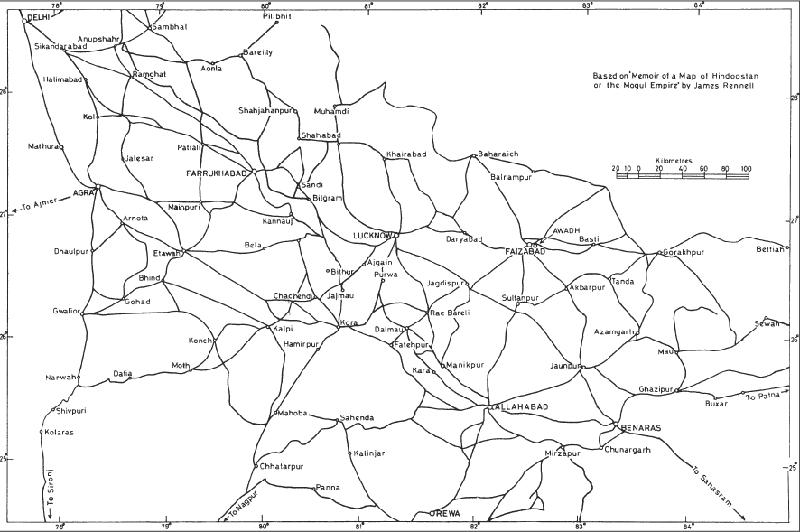
illustrated from the fact that Rad Andaz Khan combined his faujdari of (the core of) Baiswara with that of Dalmau, even though the latter was a pargana in suba Allahabad, and that he also asked for a control over the imperial highway (shahrah) from Rai Bareli, Lucknow through Sandila, Mandiaon and Mallanwan to the Ganga before Qanauj.42 The entire 3. Routes connecting Awadh with area of the southern and central parganas of Awadh as also of parts adjoining areas of suba Allahabad, extending upto Rai Bareli, Salon and Dalmau on its southern and south-eastern borders were being rapidly connected with each other, to be identified broadly as one region. A very large part of this region was endowed with a rich soil and a good natural irrigation, favouring particularly impressive cultivation. Baiswara, according to C. A. Bayly, provided ‘a good example of agricultural intensification’, leading to the emergence of a new set of qasba towns on the lineage centres of the Bais in the eighteenth century.43 The fact that Bais Rajputs themselves emerged as merchants, linking Baiswara with some distant major commercial centres by 1790, shows the extent of monetization in the region.44 A measure of the growth of the region was the establishment of new mandis and puras in Lucknow, resulting in the increase in the income from khalisa mahal of the city. The setting up of three faujdaris, Bilgram, Baiswara and Dalmau in the region also indicated the strength and importance of its local magnates.45
In this connection the rise in the jama dami (assessed revenue in dam) of the region which had almost doubled since the time of the Ain-i Akbari is also to be noted. The aggregate rise in the jama of the province, according to an eighteenth-century revenue roll, was by over 85 per cent since the late-sixteenth century, the maximum, 267.37 per cent, being in sarkar Gorakhpur, followed by 116.14 per cent in sarkar Khairabad, 82.66 per cent in sarkar Lucknow, 55.16 per cent in sarkar Bahraich and 43.40 per cent in sarkar Awadh.46 A very large part of Gorakhpur was under (p.106) forest in the sixteenth century, and its exceptionally good performance apparently owed to the special attention the Mughals paid to habilitate the sarkar under the new name of Muazzambad.47 The faujdar of the sarkar in the late-seventeenth century was often a noble of high rank, sometimes also holding charge of the province.48
The rise in jama may have reflected a mere readjustment of the revenue figures to the rising prices following the influx of silver in the seventeenth century. But it is well nigh impossible to work it out, as we have no information on the prices
Page 8 of 37
148The Zamindars, the Madad-i Ma‘ash Holders and Mughal Administration in Awadh
c. 1707–1722
of the region. The increase in prices, over a span of 150 years since c. 1600, has been calculated by about 300 per cent,49 while in no region of Awadh did the jama rise so spectacularly. The differences in the rate of the rise in jama figures of the contiguous areas of the same sarkar and dastur (revenue rate) circle, as also some evidence of urban developments, suggest that the rise in jama had a bearing on the actual production of the region. There was a difference of over 20 per cent in the increase in the jama of Saipur (47.26%) and Jhalotar (68.45%) which lay in close proximity with each (p.107) other in the same dastur circle south of the river Sai in sarkar Lucknow, while about 64 kms to the south-east in the same area, pargana Panhan differed from Saipur in this respect by 69.31 per cent, the rise in jama there being 116.57 per cent. Panhan also differed radically from its close neighbours, Ranbirpur for instance, which lay at a distance of about 16 kms to the north.50 A major factor in the difference in the rate of the rise of the jama of closely placed parganas seems to have been the availability or otherwise of good irrigation due to their location in relation to the rivers of the area. This suggests that the revenues of our period reflected the state of agriculture. Even if we assume that the rise in jama did not have any relationship with production and speculate a complete correspondence between it and the prices, this meant there was no actual rise in the state demand, to the obvious benefit of the intermediaries.
In this context, it is interesting to note the remarks of the qanungos in the earlyeighteenth century when Burhan-ul-Mulk visited Baiswara to estimate the state of agriculture in the region. According to one tradition, early in Muhammad Shah’s reign when Burhan-ul-Mulk took over the charge of Awadh as its governor, he made a tour of Baiswara in a bid to deal with the turbulent zamindars and set right the revenue administration. When he summoned the local qanungos and asked for the revenue-roll, the latter enquired as to which revenue roll the Nawab wanted, ‘the man’s’ or ‘the coward’s’. On being asked the meaning of their answer, they explained that there were two figures which a qanungo could give. In a ‘coward’s roll’, against every land owner’s name was written only the sum which had been fixed for him at the last assessment but in the ‘man’s roll’ every one’s rent was indicated on the basis of what it should have been, taking into account the improvement that had taken place in land. Burhan-ul-Mulk asked for the ‘man’s roll’ and on that basis reportedly doubled the assessment.51
The rural disturbances thus showed the strength of the region in relation to the Mughal state, amply demonstrated in the establishment of fortresses (ihdas-i qila/qilacha) and the raising of armed bands of (p.108)
Page 9 of 37
149The Zamindars, the Madad-i Ma‘ash Holders and Mughal Administration in Awadh
c. 1707–1722
Dominant zamindar Parganas Leaders of revolts in the castes in the Ain 52 early 18th-century 1. Ibrahimabad, Ansari Kanhpuria Rajputs sarkar Awadh 2. Kheri, sarkar Bisen, Rajput, Janwar Gaur Rajputs Khairabad 3. Laharpur ” Brahman Gaur Rajputs 4. Bijnaur, sarkar Chauhan Bais Lucknow 5. Ranbirpur ” Bais, Brahman Bais 6. Harha ” Bais Bais 7. Unao ” Saiyid Bais 8. Deora ’ Rajput Bais 9. Jhalotar ” Chandel Bais 10. Dewi ” Rajput Afghan
kin folks and mercenaries (sipah-o-jami‘at) by the zamindars. Rich and resourceful as they were, they now aspired to have a greater share in power and authority over the territories under their zamindaris. In this, however, only those zamindars who had a large clan strength in their zamindaris or at least readily available support from the neighbourhood on caste and kin ties, could afford to launch a sustained resistance against the imperial power. It appears that in some cases, the local upheavals also represented a powerful zamindar clan’s struggle to bring under their hegemony the entire territory of their residence. Their antagonism, in such cases, was directed not only against the state but also the zamindars of other denominations who may have been settled and encouraged by the Mughals with a view to corroding the bastion of a given zamindar caste and clan. In this connection it is interesting to compare, as we have done for some parganas, the dominant zamindar castes as given in the Ain and the leaders of these revolts whom we can identify in terms of caste and clan. It would appear that in eight out of ten cases the revolts were led by those castes which were not accorded a (p.109) noticeable position in the hierarchy of zamindars in the given parganas in the late-sixteenth century. In such cases, it was not surprising that the erstwhile chaudhuris like the Saiyids of Baiswara, for example, with their caste and community following sided with and also sought help from the Mughals against the so-called mufsids (disturbers).53
It may be noted here that the political recognition of ‘the chiefs of stratified lineages’ by the central government in the parganas in the sixteenth century did not, in all cases, buttress the cohesion of only these lineages. In a number of
Page 10 of 37
150The Zamindars, the Madad-i Ma‘ash Holders and Mughal Administration in Awadh
c. 1707–1722
cases the other kin groups who could not obtain a superior position in revenue administration also acquired eminence during the course of Mughal rule in Awadh in the seventeenth century. This had a bearing on the developments that entailed changes in the caste composition of the zamindars. It is not perhaps fair to suggest that in pre-industrial India the dominant clan territories strictly coincided without any change with the administrative and revenue units.54 The state and more than it, certain conditions—a money economy and land market which emerged in the seventeenth century broke the continuity between the government boundary and kin territory. Indeed, the pargana organization of Akbar who tried to weaken and liquidate the solidarity of the kin and clan groups at local levels did not succeed in all cases in all regions. The failure, in a measure, is reflected in the fact that the revenues of a very large number of the parganas in Awadh, which had so thoroughly been brought under the imperial regulation, are given in round figures in the eighteenth-century roll.55 For example, the rounding up in thousands of the revenues of 27 out of 54 and 13 out of 25 parganas in Lucknow and Khairabad respectively in our period as against only one mahal in both these sarkars in the Ain indicates how effectively the zamindars had resisted imperial regulations. But the political and economic integration of the regions and the localities under the Mughal empire certainly reduced the prospects of the local systems to emerge as viable political entities in our region.
(p.110) While it is true that the revenues in round figures in a large number of the parganas suggest a reassertion of the zamindars’ power, it is not correct to presume that these parganas were in control of the ‘autonomous chiefs’. It is also incorrect to characterize the rebel zamindars as rajas,56 implying their autonomous control over the territories under their zamindaris. The appellation of raja was adopted by some of them much later in the early years of the nineteenth century when their descendants under a different organization of agrarian relations obtained new powers and privileges. Even the so-called raja of Tiloi ‘the boldest spirit’ who ‘did not easily stoop to submit’ is mentioned in our records as ‘malguzar’,57 while a number of the rebel zamindars have been characterized as ‘ta‘alluqadars’.58 Again, one of the expressions of their defiance of imperial authority is given as ‘the refusal to pay the mal-wajib’59 which shows that the rebels were by no means rajas or tributary chieftains. They were the old and the new intermediary zamindars who endeavoured to acquire an independent or at least semi-independent status. How many of their village kinsmen and the peasants turned over to their side in the hope of escaping ‘the excessive taxation’ is a matter of conjecture. The disturbance not infrequently meant the zamindars’ refusal to pay to the Mughals the revenues already collected from the peasants.
The existing social conditions did not allow the entire region to be mobilized by the zamindars against the central government. It was well (p.111) nigh impossible for the zamindars and peasants of different castes and kin groups to
Page 11 of 37
151The Zamindars, the Madad-i Ma‘ash Holders and Mughal Administration in Awadh
c. 1707–1722
fight together against the Mughals. The traders and artisans saw little to gain from these battles which apparently hit their interests as well.60 Thus the solution to the problem, in a large measure rested, as it actually happened in the case of Burhan-ul-Mulk and Safdar Jang when they acted virtually independently in provincial matters, on how willing and able the Lucknow government was to accommodate the aspirations of the zamindars. The emergence of Dondia Khera, Jahangirabad, Katesar and Tiloi as important ta‘alluqadaris in the eighteenth century is to be seen in this light. It was perhaps possible to contain the turbulent zamindars within the existing framework of provincial administration. But the steadily increasing estrangement between the governor and the diwan, the two principal officials in the province added to the enormity of the problem. The central government, engaged in its own factional politics, gave little serious attention to local problems. These were generally left to the local officials who were unable to meet the situation with the resources at hand, and in order to protect their own interests, not infrequently, had to ally with powerful zamindars. Chin Qilich Khan had to leave the province within six months of his appointment. Muhammad Amin Khan never came to Awadh and Sarbuland Khan, when assessed on the basis of his work in Gujarat and Allahabad, was a man of ordinary achievements. By obtaining the office of the diwan for his own associate, Chhabele Ram did muster sufficient resources to deal with the problems effectively. Besides, being more or less a local person he was familiar with the geography of the province as well as with the social roots of the uprisings. He failed because he had to constantly face opposition from the wazir. His nephew Girdhar Bahadur, who was free from such hostility from Delhi, made some headway. The imperial forces in one of his campaigns against the zamindars are reported to have been reinforced by a large contingent of the local zamindars. He was, however, very soon removed to Malwa where his services were thought to be more urgently needed.
(p.112) Moreover, an unfortunate rivalry among the governors themselves was also responsible for the stalemate. The succeeding governor instead of carrying out the unfinished tasks of his predecessor was more concerned with a show of independent strength and power. For instance, immediately after the removal of Sarbuland Khan, Girdhar Bahadur, the new governor’s nephew, carried a successful campaign against the Gaurs of sarkar Khairabad. But he paid no attention to the neighbouring fortress of Noner which was held by the rebel zamindar and marched towards Katesar. The fortress had been reduced after a 28 day long seige by Sarbuland Khan. The reason for this indifference is given by Chhabele Ram in his letter to the court as ‘in this case [in the case of the reconquest of Noner] the people would remark [rather sarcastically] that he [Girdhar] beat what had already been beaten by Sarbuland Khan.’61 Thus as the agrarian uprisings caused and accelerated the imperial decline, they too in turn were accentuated by the process of decay.
Page 12 of 37