INTRODUCTION
This View of Life

Whatever you think you currently know about evolution, please move it to one side to make room for what I am about to share in the pages of this book. I think you’ll find that my argument doesn’t fall into any current category. Politically it isn’t left, right, or libertarian. It’s not anti-religious and it enables us to think more deeply about religion than ever before. Above all, it moves us in the direction of sustainable living at all scales. Who doesn’t want to improve their personal well-being; their families, neighborhoods, schools, and businesses; their governments and economies; and their stewardship of the natural world? These goals are within reach—but only if we see the world through the lens of the right theory.
To begin, we need to do a bit of clear thinking on what science is. It is commonly portrayed as a contest between theories that are based on a common stock of observations. First we see and then we theorize. Theories that do the best job of explaining the observations are accepted, only to be challenged by another round of theories, and so on, bringing our knowledge of the world closer to reality.
The problem with this view of science is that the common stock of observations is nearly infinite. We cannot possibly attend to everything, so a theory—broadly defined as a way of interpreting the world around us—is required to tell us what to pay attention to and what to ignore. We must theorize to see. A new theory doesn’t just posit a new interpretation of old observations. It opens doors to new observations to which the old theories were blind.
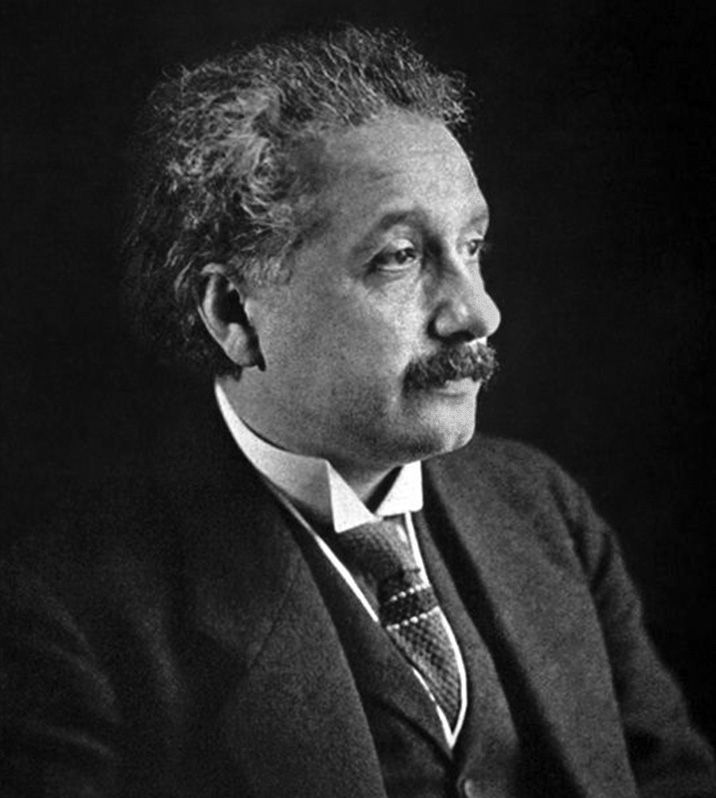
Albert Einstein
Albert Einstein understood this point when he wrote, “It is the theory that decides what we can observe.” He was corresponding with his colleague Werner Heisenberg about electron orbits inside atoms. There was no way to directly observe electron orbits at the time, and Heisenberg thought it prudent to theorize on the basis of what can be observed. Einstein understood that theorizing about entities that cannot yet be seen can lead to useful predictions about what can be seen, but which had previously gone unnoticed.
Charles Darwin experienced the blindness that comes from lack of the right theory as a young man on a fossil-hunting expedition with his professor Adam Sedgwick. The valley in Wales that they visited had been scoured by glaciers and therefore had no fossils. The evidence for glaciers lay all around them—the scored rocks, the perched boulders, the lateral and terminal moraines, all typical of a glaciated landscape. Yet Darwin and Sedgwick were blind to the evidence because the theory that vast sheets of ice had once covered much of the northern hemisphere had not yet been proposed. They didn’t know what they should have been looking for. Darwin commented in his autobiography that “a house burnt down by fire did not tell its story more plainly than did this valley. If it had still been filled by a glacier, the phenomena would have been less distinct than they are now.”
Darwin went on to contribute his own eye-opening discoveries with his theory of natural selection. The theory is amazingly simple: 1) Individuals vary; 2) Their differences often have consequences for survival and reproduction; 3) Offspring resemble their parents. Given these three conditions, populations will change over time. Traits that contribute to survival and reproduction will become more common. Individuals will become well adapted to their environments.1
The theory of natural selection is so simple and rests upon such firm assumptions that it seems obvious in retrospect. As Thomas Huxley famously remarked upon encountering it for the first time, “How stupid of me not to have thought of that!” Nevertheless, for those who first started to explore the implications, it was as if the scales had fallen from their eyes. Wherever they looked—the fossil record, comparative anatomy, the geographical distribution of species, and the many wonderful contrivances that adapt organisms to their environments—they found confirming evidence. In the contest of theories, the biblical account of creation didn’t stand a chance. By 1973, the geneticist Theodosius Dobzhansky could declare that “nothing in biology makes sense except in the light of evolution.”2
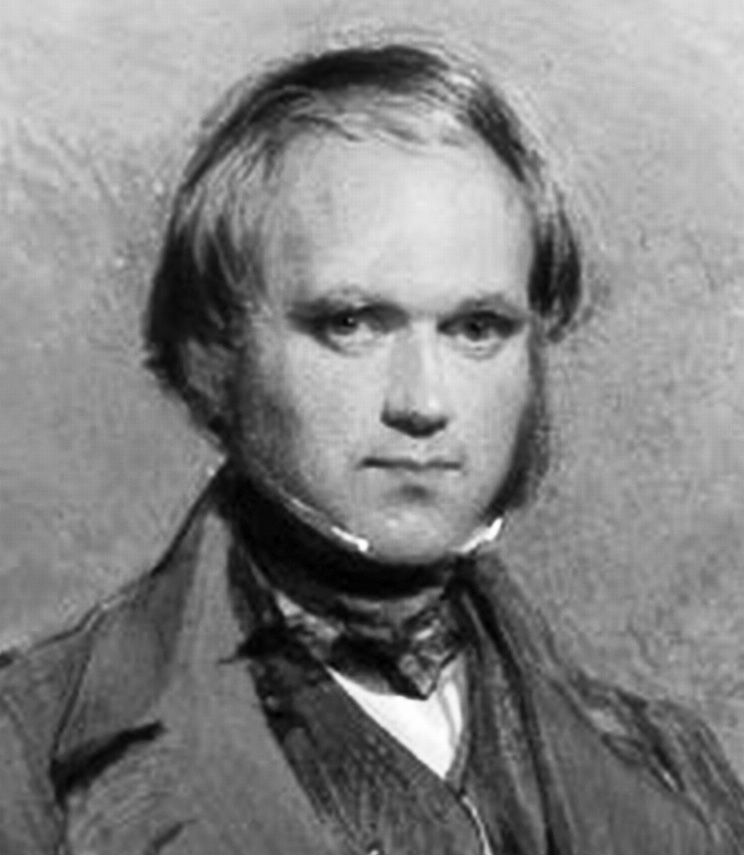
Young Charles Darwin
MY STORY
I was a graduate student at Michigan State University in 1973 and my personal experience can help to explain what Dobzhansky meant by his imperious-sounding proclamation. As someone who loved the outdoors and aspired to be a scientist, I decided to become an ecologist so I could study animals in their natural environments. In keeping with the old joke about experts knowing more and more about less and less until they know everything about nothing, my research was focused on the feeding behavior of a tiny aquatic crustacean called a copepod. Even for this esoteric subject, the possibilities were endless. Copepods might select their food in any number of ways and a theory was needed to narrow the possibilities. Evolutionary theory predicts that copepods should feed in ways that enhance their survival and reproduction. This could mean maximizing the amount of energy harvested, feeding in a way that avoids being eaten by predators, or other possibilities that depend upon the details of the environment. No theory leads directly to the right answer. The best that a theory can do is to narrow the field of possibilities. In this case, I predicted that copepods might selectively graze on larger algae rather than harvesting algae without respect to size, which would increase their rate of energy intake. My prediction turned out to be correct and resulted in my first publication in 1973.3 I had added one small but solid brick to the edifice of scientific knowledge. I couldn’t vouch for Dobzhansky’s claim for all of biology, but I could testify that evolutionary theory had helped to make sense of my little corner.
Later that year I traveled to Costa Rica to attend a course in tropical ecology run by the Organization for Tropical Studies (OTS), a network of field stations run by a consortium of universities that is still going strong after fifty years. It was a life-changing experience. Anyone who loves nature is thrilled by the tropics, but we were seeing all of those wonderful plants and animals through the lens of evolutionary theory—the same lens that informed my esoteric research. I realized that I didn’t need to spend my life studying copepods. I could pick any creature or topic that interested me and quickly start asking intelligent questions based on the logic of evolutionary theory. It was the opposite of the old joke about experts knowing more and more about less and less. Becoming an expert in evolutionary theory was like receiving a passport to the study of all aspects of life.
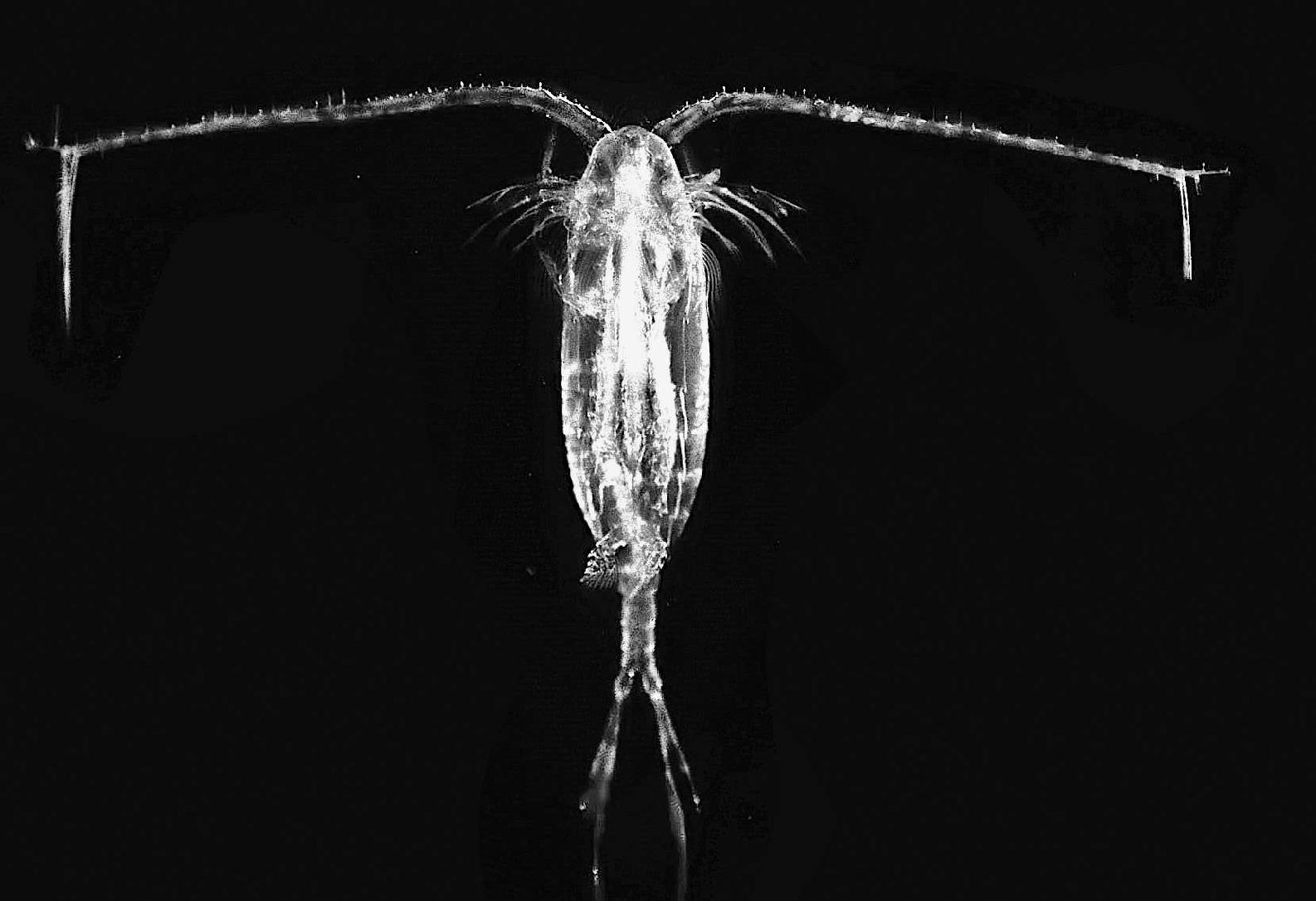
A copepod, my first scientific love
Ever since, I have used evolutionary theory to study a multitude of creatures and topics. I have also witnessed my field of biology become ever more sophisticated in observational techniques. The modern biologist is like Darwin with superhuman powers of observation.4 He or she can catalog entire genomes and track the patterns of gene expression (epigenetics); can trace neural pathways inside the brain; can monitor the movement of animals via satellite; can measure climate change in the distant past with a high degree of accuracy; can experiment with evolution in the laboratory using microbes that can be frozen and brought back to life to compare with their own descendants.
These technological marvels bring the common stock of observations well beyond anything imagined in Darwin’s day. The role of evolutionary theory in making sense of all this information is more important than ever before. Dobzhansky’s 1973 statement that nothing in biology makes sense except in the light of evolution has withstood the test of time. Yet for many people the word “biology” conjures up a different set of associations than words such as “human” or “culture.” To proceed further, we need to expand the scope of what we consider biology.
HOW ABOUT US?
Darwin was convinced that his theory could explain the length and breadth of humanity, in addition to everything else more typically associated with biology. He observed and kept notes on his children with the same discerning eye that he observed barnacles and orchids. Following upon On the Origin of Species, he developed his thoughts at length in The Descent of Man and other works.
Yet, as evolutionary biology became a branch of science, the study of humanity did not proceed along the same track. The problem was not just the collision with religious belief that remains with us today. Some people who were fully comfortable with a naturalistic conception of the world still had an allergic reaction to evolutionary theory in relation to human affairs. As early as the 1870s, the threat that they perceived was given a name: social Darwinism.
According to most people’s conception of social Darwinism, the haves and have-nots of society are equivalent to the fit and unfit of evolutionary theory. It is nature’s way for the fit to replace the unfit. Interfering with the process would degrade the species and lead to the collapse of society. It is not selfish for the fit to replace the unfit; it is a moral imperative. Policies that flow from this logic include laissez-faire capitalism, withholding welfare from the poor, forced sterilization, and genocide.
After the excesses of the Gilded Age, the eugenics policies enacted in America and Britain, and the genocidal horrors of World War II, the idea of using evolutionary theory to formulate public policy became unthinkable. The stigma carried over to the academic disciplines classified as the social sciences and humanities. While these areas of study developed into sophisticated bodies of knowledge, they largely avoided engaging with evolutionary theory.5 Most humanist scholars were happy to accept Darwin’s theory for the study of the rest of life, our physical bodies, and a few basic instincts such as to eat and have sex, but insisted that our rich behavioral and cultural diversity operated according to a different set of rules.
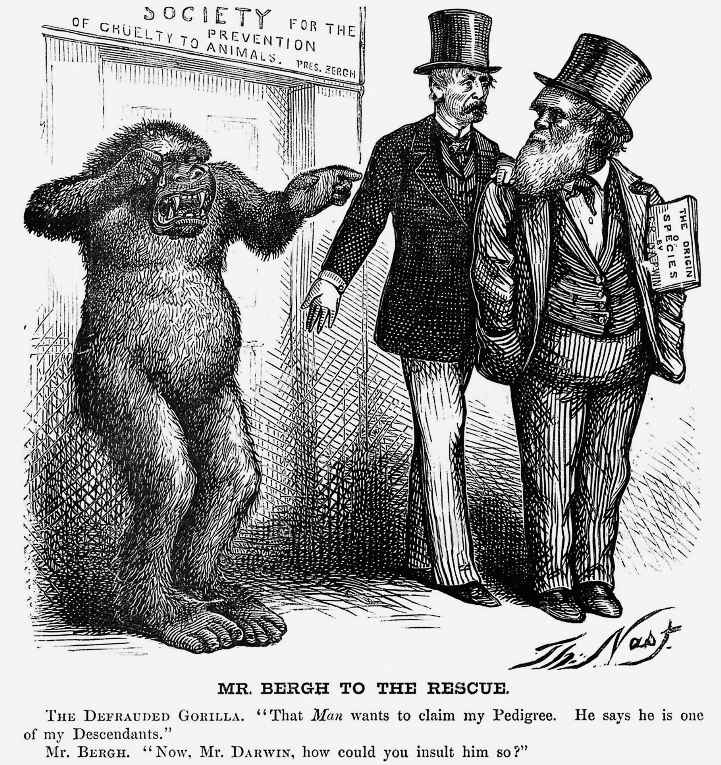
The cartoonist Thomas Nast makes fun of Darwin’s theory that we are descended from the apes.
AN INTELLECTUAL APARTHEID
The publication in 1975 of the book Sociobiology: The New Synthesis by Edward O. Wilson reveals the intellectual apartheid that was in place at the three-quarter mark of the twentieth century. The thesis of Wilson’s book was that evolution provides a single theoretical framework for understanding the social behavior of all species, from microbes to humans. It was regarded as a triumph except for the final chapter on humans, which created an uproar—complete with accusations of fascism. Someone even dumped a pitcher of water onto Wilson’s head at a conference because they were so offended by the perceived implications of his arguments.
Thus, at the same time that Dobzhansky could declare that nothing in biology makes sense except in the light of evolution, evolutionary theory was vigilantly being kept out of the social sciences and humanities. A full century had been lost. Terms such as evolutionary psychology, evolutionary anthropology, and evolutionary economics weren’t coined until the 1980s, signaling a renewed attempt to rethink these disciplines from an evolutionary perspective—and even these had the whiff of scandal about them.
Today, I’m happy to report that the academic study of humans from an evolutionary perspective is getting back on track. Open any issue of a premier academic journal such as Science, Nature, and the Proceedings of the National Academy of Sciences, or any of hundreds of specialized academic journals, and you will find articles that view the length and breadth of humanity through the lens of evolutionary theory as if it is uncontroversial—just as biologists study the rest of life. However, there is a lot of catching up to do. Evolution is still taught primarily as a biology course at most colleges and universities. Many professors in the social sciences and humanities, who received no evolutionary training during their student days, are unlikely to modernize their views. Even most evolutionary biologists still associate evolution with genetic evolution, ignoring the fact that cultural change is also an evolutionary process—the key insight of Teilhard almost a century ago. The scientists and scholars who are back on track might number in the thousands, but this is a tiny fraction of the worldwide academic community.
When we move from the world of academia to the world of politics and public policy formulation, the situation gets even worse. Evolution is still a toxic word in the political arena. In addition to losing the creationist vote, it still invokes the specter of social Darwinism in the minds of many people. Even politicians and policy experts who are open-minded about evolution typically don’t have the slightest idea how evolutionary theory might inform their particular corner of the policy world.
PILGRIM’S PROGRESS
Let’s take stock as we begin our journey. The claim of this book is that a firm knowledge of evolutionary theory, which includes our own species, is required to solve the problems of our age. Yet, our current knowledge of humanity and our many attempts to improve our circumstances are to a large extent pre-Darwinian.
This claim will probably sound strange to most readers. I am not referring to the collision between evolutionary theory and religious beliefs. I am not even referring to a conscious denial of evolutionary theory for any reason. These topics can be set aside, at least for the moment. A person can fully endorse a naturalistic view of the world, including the fact of evolution, and still be pre-Darwinian.
To explain what I mean, let’s return to Darwin and Sedgwick looking for fossils in the Welsh valley scoured by glaciers. A particular theory was required to make sense of what lay around them. No other theory would do. Our current knowledge of humanity and our many attempts to improve the human condition with public policy consist of hundreds of theories and rationales that are too informal to call theories but nevertheless draw our attention to some possibilities and blind us to others. Most of them are “local” theories, which means that they attempt to explain a limited range of phenomena without pretending to have more general explanatory scope. They are seldom related to each other or to any general theoretical framework, much less evolutionary theory. This is radically different than the conventional biological sciences, where all topics are approached from a single theoretical perspective.
Scientists, scholars, politicians, and policy experts might think that their theories and rationales are consistent with evolutionary theory, but in the absence of explicit inquiry there is no way to know. When these topics are approached from an evolutionary perspective, massive problems in the ways they have been conceptualized are often revealed. And new possibilities emerge that in retrospect are so obvious that a house burnt down by fire would not tell its story more plainly.
Dozens of examples will be provided in the pages of this book, but consider the economics profession as a foretaste. It includes many schools of thought, but the dominant school is inspired not by Darwin’s theory of evolution but by nineteenth-century physics, as if an economic system can be predicted with the same kind of mathematical precision as the orbits of planets around the sun in our solar system.6 Even though the Norwegian-American economist Thorstein Veblen wrote an article titled “Why Is Economics Not an Evolutionary Science?” in 1898,7 the term “evolutionary economics” was not coined until the 1980s,8 reflecting the more general intellectual apartheid that I have already recounted. Today, evolutionary economics is a tiny heterodox school of thought with almost no influence on economic policy. One prominent economist who gets it right is Robert Frank, who predicts that within a hundred years, Darwin and not Adam Smith will be regarded as the father of economics.9 If he is correct, then it will have taken over two centuries to complete the Darwinian revolution for this topic area, and we are still only a little more than halfway there!
Economics is one of a very few disciplines in the social sciences and humanities that even pretends to have a unifying theoretical framework. Most other disciplines, such as political science, sociology, history, psychology, and education, are nothing more than a constellation of schools of thought that are poorly related to each other, much less to evolutionary theory.
TOWARD AN EVOLUTIONARY WORLDVIEW
Completing the Darwinian revolution therefore requires a massive reset in our understanding of humanity, which must take place at a timescale of years, not decades. We need not just a theory that states what is, but a worldview that informs how we ought to act, while remaining fully within the bounds of scientific knowledge. Here is a preview of the voyage that we will be taking in the pages of this book.
We must begin by confronting the dark past of social Darwinism. Is it true that Darwin’s theory unleashed a plague of toxic policies justifying social inequality and is inherently more dangerous than other theories? The answer to this question is more complex and intriguing than you might think.
Next, I show how evolutionary theory provides a toolkit for making sense of any living process—a fact that is already accepted for biology. I use the word “toolkit” to invoke the mindset of a plumber or carpenter: someone who arrives at a site, sizes up the job, and pulls out the right tools to get the job done. Anyone can become adept at this kind of work—including you—and I can get you started within a single chapter.
Once we are equipped with a toolkit, we can get right to work addressing problems that everyone wants to solve, such as our physical and mental health and optimal ways to raise our children. Along the way, we will see that there is no dividing line between “biology,” “human,” and “culture.” The same conceptual tools are useful for making sense of everything associated with these three words.
The next step in our journey turns what religious believers call “the problem of evil” on its head. Their problem is to explain how everything associated with the word “evil” can exist in a world created by an all-powerful and beneficent god. The problem of the evolutionist is to explain how everything associated with the word “goodness” can evolve in a Darwinian world. Modern evolutionary theory tells us that goodness can evolve, but only when special conditions are met. That’s why we must become wise managers of evolutionary processes. Otherwise, evolution takes us where we don’t want to go. Along the way, we’ll see how the same toolkit can make sense of examples as diverse as cancer, psychopathic chickens, and the very nature of human morality.
If you’re like most people, you probably regard evolution as such a slow process that it stands still for the timescales that matter most to us. That’s not necessarily true even for genetic evolution, which can take place in a single generation. Once we appreciate that evolution goes beyond genetic evolution, however, we can begin to use our toolkit to understand the fast-paced cultural changes swirling all around us and even within us as actively evolving entities in our own right.
The problems that require our attention exist at all scales, from individual well-being to a sustainable planet. Evolutionary theory distinctively identifies the small group as a fundamental unit of human social organization, required for both individual well-being and effective action on a larger scale. Nearly every reader of this book can become happier as an individual and more engaged as a citizen by creating and joining small groups. Yet, small groups don’t automatically work well, and even when they do, they can become part of the problem higher up the scale, such as a street gang, a terrorist cell, a predatory corporation, or a rogue nation. We must consciously seek to create small groups that benefit individuals as well as society as a whole.
It is one thing for a species to be well adapted to its environment and another for it to be adaptable to environmental change. The same goes for human cultures, and almost no existing culture is adaptable enough to keep pace with our ever-changing world. Conscious evolution requires the construction of a new system of cultural inheritance capable of operating at an unprecedented spatial and temporal scale. This will be a formidable task, but evolutionary theory does provide the tools to get the job done.
Our journey ends with a reflection on how the secular imagination and the religious/spiritual imagination can converge on the conscious evolution of our collective future. It is striking how these two imaginations often seem at odds with each other, yet both arrive at the same conclusion: that the concept of “organism” has a movable boundary, which must be expanded to solve the problems of our age. It’s as if two separate languages are being spoken, each of which apprehends the same reality in its own way but which are mutually unintelligible to most of their speakers. In my own journey, I have learned to speak both languages and to appreciate how they both add value to consciously evolving our collective future. I hope that by the end of this book, you will become bilingual as well.