117The Punjab and the Case for Imperial Control For various reasons, from the beginning of our period, the dominant but mutually hostile sections of the nobility were actively interested in retaining a measure of control over one or the other area of the Punjab. In 1707 Prince Muhammad Muazzam (Bahadur Shah) was the governor of the Punjab and Kabul, and Mun‘im Khan was his naib in the Punjab. Mun‘im Khan also held the post of diwan of the province.53 After Bahadur Shah’s accession to the throne, Mun‘im Khan, being the chief architect of the new emperor’s victory was made wazir and for Asad Khan, erstwhile wazir of the empire, the old office of vakil was revived. In the face of a strong wazir, the office of vakil carried little weight and its revival, as we know, was primarily motivated by the necessity for conciliating the leaders (Asad Khan himself and his son, Zulfiqar Khan) of a powerful group of the old nobility at the court.54 Asad Khan’s appointment to the subadari of Lahore (26 July 1707), in addition to his office of vakil, which had so far been under Mun‘im Khan very likely formed part of the conciliation. It is also possible that the emperor tried, even though it was not so evident as in the case
Page 10 of 32
118The Changing Position of the Governor
of Chin Qilich Khan, to divert Asad Khan’s attention from the centre to a province.
As Asad Khan aspired to hold a key position at the court and was too old to govern the province in person, the struggle for power in the Punjab initially centred around the office of the deputy governorship (niyabat). Further, a number of important faujdaris, e.g., Jammu, Beth Jalandhar and chakla Gujarat were also at issue between the wazir and Asad Khan. Some of the major offices in the Punjab were under the control of the governor’s associates.55 This was, however, in consideration of Asad Khan’s personal status. (p.77)
(p.78) When Asad Khan tried
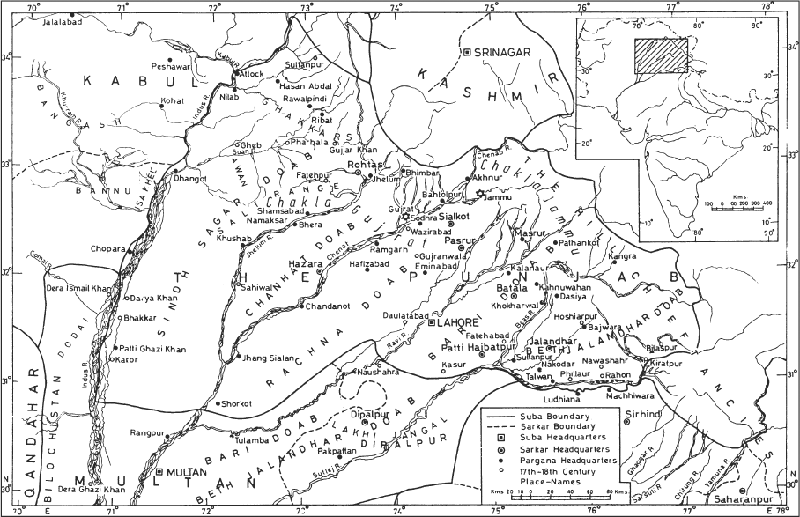
to maintain actual power both at the centre and in the province, he was ordered to stay away from the court in Delhi and Mun‘im Khan, the wazir was allowed to impose a check upon him. Asad Khan’s associate56 who held the office of niyabat and the faujdari of Jammu was replaced by an 2. The Punjab and adjoining areas associate57 of the wazir. Later when Asad Khan tried to mollify the emperor, his associate was reinstated to the niyabat.58 But the faujdari of Jammu and for that matter even some other important faujdaris of the province like Beth Jalandhar, chakla Gujarat, Emanabad and Wazirabad remained outside the control of Asad Khan. It may be noted that Jammu and Jalandhar were not only large in size but also occupied a special position as a number of the chieftains in the Punjab came under the jurisdiction of these faujdaris, while the revenue of chakla Gujarat, Emanabad and Wazirabad sustained a substantial part of the imperial expenditure in Kabul.59
The imperial policy of not allowing the privileges of the governor to grow into a new source of strength is further illustrated from the appointments in the province in 1711, when following the death of Mun‘im Khan (28 February 1711), Prince Muhammad Azim-ush-Shan assumed supreme position at the centre. Asad Khan’s associates in the province seem to have been gradually replaced by persons who for one or the other reason were attached to the prince, then the real authority behind (p.79) the emperor.60 Besides, some replacements at different levels took place in the office of the bakhshi waqaiʿnigar.61 The office of the bakhshi waqaiʿnigar, not only formed part of the imperial intelligence but also maintained the provincial army’s connection with the centre and was thus a major check upon the local officials.
Page 11 of 32
119The Changing Position of the Governor
These changes may be seen in the light of the emperor’s attempt to keep the ambition of the nobles in check. Asad Khan’s son, Zulfiqar Khan had again staked his father’s claim to the wizarat. He thus aspired to combine in his family the two highest offices of the centre—the wizarat and the mir bakhshi-ship together with the viceroyalty of the Deccan and the governorship of an important northern province. However, the growing Sikh menace also had obvious connections with these attempts. Asad Khan and Zulfiqar Khan were inclined to deal with the Sikh question cautiously and tactfully. Asad Khan had failed to give a prompt and efficient response to a farman from Bahadur Shah in early 1711. The emperor, therefore, struck at his control over the intelligence and the army organization in the province, and wrested from his associates, the faujdari and the qiladari in the areas affected by Sikh activities.
It will be seen that during the first phase of our period, namely, Bahadur Shah’s reign, the governorship of the Punjab, as of Awadh, (p.80) was vested in the leader of a powerful but dissatisfied faction of the nobility. In both cases, the emperor tried to control the ambitions of the governors even though they had certain privileges. Two peculiar factors, however, distinguished the case of the Punjab. In the first place, Munʿim Khan, the wazir, keenly followed developments in the Punjab, since he had served there and recognized the importance of Delhi’s control over the province for the north-western frontiers of the empire. Indeed, with a view to retaining imperial authority over the province, Munʿim Khan tried to win over some powerful nobles with a local base in the Punjab, and place them in authority in or around the province.62