179The Sikhs, the Zamindars and the Madad-i Wa‘ash Holders
The zamindars in the Punjab, like most of their counterparts in the northern provinces of the Mughal empire, had taken full advantage of Aurangzeb’s involvement in the Deccan. They had been up in arms against Mughal authority during the last phase of Aurangzeb’s reign. Mun‘im Khan, the deputy governor of the Punjab, is reported to have raised a strong army to deal with the refractory zamindars of sarkar Beth Jalandhar and Jammu who had become a menace to merchants and travellers. Also, he had often to cross the Sutlej into the territory of sarkar Sirhind in suba Delhi along with the imperial artillery (topkhana) and wage battles against the rebels.6
It appears that Banda Bahadur drew principal strength from the support of the zamindars. According to the observation of a contemporary (p.139) ersian chronicler, Banda appeared first at Kharkauda, about 30 miles north-west of Delhi. The zamindars promptly put their trust in Banda and accepted him as their leader. At their instance, hundreds of others collected around Banda and in all directions the Sikhs were apprised of his appearance.7 Moreover, a large number of the zamindars of the parganas along both sides of the Beas and the Ravi and the Shah Nahr (the canal) sympathized and acted in collusion with the Sikhs of Banda.8 During the entire period of their struggle against the Mughals, the Sikhs of Banda could move almost unchecked in the northern districts of the Bari Doab.9 The zamindars of these districts supplied arms and horses to Banda when he retreated and took shelter in the hills, following the arrival of Bahadur Shah in the Punjab and the deployment against the Sikhs of the entire Mughal army of the northern provinces.10 The villages of this region remained under Banda’s control till as late as the middle of 1714. The faujdar of Kangra had to set up special chaukis (watch-houses) to deal with the zamindars who collected foodgrain and other provisions for the Sikhs.11
The fact that the second important region where Banda had a strong following lay on the south-eastern borders of the Punjab in chakla Sirhind of suba Delhi12 created additional problems for the Mughal government. It not only threatened
Page 3 of 40
180Mughal Power, the Sikhs and Other Local Groups in the Punjab
to bring the Mughal capital at any moment within the striking reach of the Sikhs, but also to cut off Mughal Punjab from the rest of the empire. We have seen how promptly the zamindars of Kharkauda in the cis-Sutlej area put their trust in Banda who launched his campaign from Sirhind.13 He considered the region secure enough to make it the base for his operations beyond the Yamuna in (p.140) (p.141) sarkar Saharanpur.14
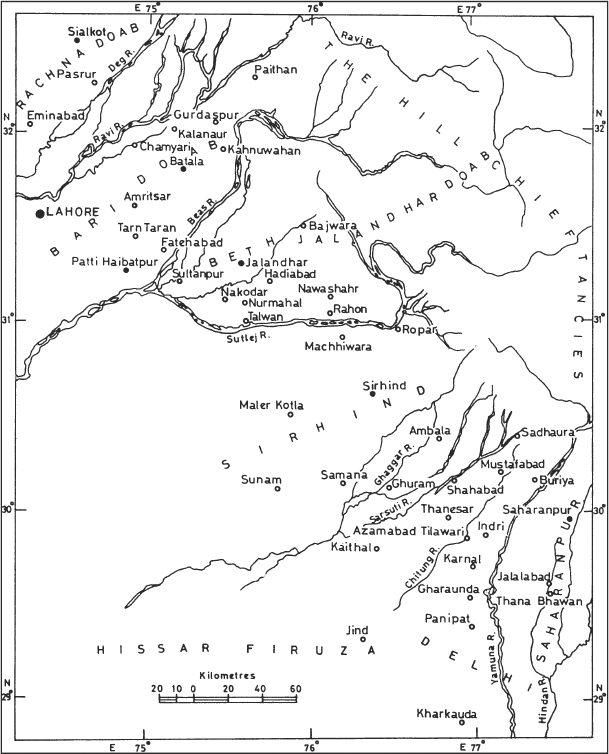
Almost the whole region fell to the Sikhs during the first phase of Banda’s wars against the Mughals. It is true that soon after, Bahadur Shah’s personal command of the campaigns restored imperial authority in the region. But Banda easily recaptured the parganas of chakla Sirhind and installed his own thanas in the wake of the disturbances following the death of the emperor in 1712.15 In moments of extremity when the Sikhs ran off into the hills, Banda could also depend on the supply of provisions for his army from chakla Sirhind.16 It is not unlikely that during the last phase of his struggle, Banda chose Sadhaura 4. Parganas affected by Sikh uprisings and its neighbourhood as the base of his operations due to its proximity with the chakla on the one hand, where he had support for his movement, and the Sirmur hills on the other where, as we shall see later, he could withdraw whenever the need arose. The Mughals were thus confronted with the Sikh menace in a large part of the northern districts of suba Delhi on either side of the Yamuna, apart from the danger posed to the two major regions of the Punjab, namely, the sarkar of Jalandhar and the upper Bari Doab. Added to this were the zamindar and tribal uprisings in the other regions of the Punjab. The Bhattis, Kharals and Gujars and some of the zamindars of the regions near Multan often posed a serious threat to the provincial government.17 It appears that in 1714–15, the Mughals had no effective control over, at least, a part of pargana Khushab in sarkar Singh Sagar Doab.18 The zamindars’ resistance had impaired imperial authority even over the khalisa villages in pargana Bahlolpur in Chanhat Doab.19 These uprisings were not linked to the movement under Banda. But being in themselves a source of threat to the Mughal government, they emboldened the Sikhs to rise.
Page 4 of 40
181Mughal Power, the Sikhs and Other Local Groups in the Punjab
It is possible to identify with some qualifications and reservations, the social composition of the zamindars who followed Banda. From a (p.142) brief reference in Khali Khan, it appears that with some exceptions, Banda led predominantly the uprisings of the Jat zamindars.20 It is also to be noted that the Jats were the largest zamindar castes in the parganas where Banda had support.21 Since the ninth century the Jats or the Jatts had been moving northward from the Sindh region where they had lived as a pastoral community. They were first noticed in Multan area in the eleventh century; sixteenth-century sources refer to their unmistakable presence in the Punjab. From the Punjab they moved across the Sutlej towards the east to settle in the subas of Delhi and Agra.22 By the close of the sixteenth century they had large areas under their zamindaris in and around the Punjab, in particular in the Rachna and Bari Doabs and in the west of the Yamuna in the sarkars of Sirhind, Hisar Firoza and Delhi of suba Delhi.23 But no exact idea of their concentration as agriculturists in these areas can be had, depending merely on the Ain’s column of the zamindars. For the zamindars listed in the Ain perhaps refer only to intermediaries.24 Their positions as intermediaries in these parganas apart, the Jats seem to have been dominant in the villages as zamindars and peasant proprietors (zamindaran-i mauza and zamindaran-i dihat). Besides, in a number of the other parganas of Bari Doab, Beth Jalandhar and the cis-Sutlej areas for which the Ain records the non-Jat as zamindars, the Jats apparently held distinct positions as agriculturists. This, in part, is illustrated from the traditions of the Jats of the southern areas of the Beth Jalandhar. The Jat village settlements in some parts of modern Jullundur district and in Phillaur tahsil are traced back to the fifteenth century, (p.143) even though the zamindars of this area, according to the Ain, were predominantly Rajputs.25
The Jats of the Punjab were thus no longer a moving band of pastoralists. A larger number of them who had acquired wealth were then looking for social recognition of their status to match their economic position. In the teachings of Sikh religion, whose rise in the region almost synchronized with their settlements in the Punjab, they found an avenue to advance and promote their claims.
The areas of the Jat concentration registered remarkable growth in the seventeenth century. The Jat population concentrated in the Indo-Gangetic plain and the sub-Himalayan zones of the Bari, Rachna and also Chanhat Doabs which together with the Jalandhar Doab, combined regular rainfall, rich soil with extensive areas of the river basins irrigated easily from wells.26 The high fertility of the soil drew the sturdy Jats to settle and become the chief agricultural community in the region, which in turn was further enriched. We may note the fact that the Jat settlements were also linked to the great route which carried the trade of the country east and south of Delhi with the Punjab and beyond with
Page 5 of 40
182Mughal Power, the Sikhs and Other Local Groups in the Punjab
Central Asia and Persia. The region also had an opening through the Indus to Lahari Bandar, an important seaport of Mughal India.27
The countries west of the Punjab were linked with the Indo-Gangetic plain through two important roads, one from Kabul through the Khybar pass and Attock and the other from Qandahar through Fushanj (Pishin) and Pir Kanu (Sakhi Sarwar). The Qandahar route crossed the Indus at points near Dera Ghazi Khan and met at Multan which connected Lahore and the other important towns of the northern Punjab lower down with Bhakkar, Sehwan, the Leti chief’s headquarters at Umarkot and Lahari Bandar both by road and the riverine route. A road from Multan across the Sutlej joined the main route via Hissar. There was yet (p.144) another important route which linked Qandahar via Sibi and Bhakkar across the Indus with the western regions of the Mughal empire.28 The commercial traffic through these routes was carried, among others, by the merchants from the region Under review. Some entries in Kamwar Khan’s account of the early-eighteenth century suggest the presence of traders in Qandahar and different parts of Iran including Tabriz from Multan and Lahore.29 Our sources also mention goods from Persia being sold by the Afghan tribes of Qandahar in Sindh.30 Mohan Lal made some interesting observations in the course of his inquiries regarding the prospects of trade in Multan in the earlynineteenth century. ‘The principal marts of Multan’, he observed, ‘are Amritsar, Bahawalpur, Khirpur, Dera Ghazi Khan, Dera Ismail Khan, Laiya, Shujabad, Mitankot, etc., which have a commercial communication with the merchants of Shikarpur, Qandhar, Herat, Bokhara, Kabul, Peshawar, Sindh, Hindustan, etc.’31 This trade was carried by Lohanis and Shikarpuris largely by means of pack animals, through ‘many roads from the places on the right bank of the Indus’ leading to Qandahar. The Shikarpuris were the Khatris who had spread themselves in almost all the regions of Central Asia and Persia.32 Mohan Lal’s description covered a part of the traditional trade of the region which appears to have reestablished itself in the times of Ranjit Singh following several decades of dislocation in the eighteenth century.33 The Khatri settlements, like Shikarpur and Gotki in Sindh, may have come up when the traders of the Punjab migrated from their ancient habitats in the north.
The Mughal province of the Punjab in the seventeenth century was among the most prosperous and rich territories of the Mughal empire.34 Lahore was regarded ‘as the greatest city of the East, surpassing (p.145) even Constantinople.’35 A number of towns and Sikh settlements, e.g., Jahangirabad, Wazirabad, Ibrahimabad Sodhra, Rahon, Phillaur, Nur Mahal, Dera Baba Nanak, Tarn Taran, Amritsar, Hargobindpur, Anandpur, Kiratpur, Kartarpur and Hoshiarpur emerged and flourished in the late-sixteenth and the seventeenth century.36
Page 6 of 40
183Mughal Power, the Sikhs and Other Local Groups in the Punjab
The prosperity of the region is reflected in the increase in the revenues in the seventeenth century. According to our sources, the revenues of the Mughal Punjab since the time of the compilation of the Ain rose from, 55, 94, 58, 423 to 1, 06, 64, 19, 937 dams in Aurangzeb’s times with the hasil being Rs 2,00,35,791/8¼, 75.15 per cent of the jama. What is significant that beside 254 mahals, 5 tappas and one mauza of mal, there were 60 mahals of sair, given as baldah waghairah (town, etc.), with Rs 12, 77, 379/10 of the hasil of these mahals in khalisa.37 This indicates that the prosperity of the province had a bearing on the growth of trade of and through the region. This is also illustrated from a substantial increase in the number and rearrangement of the mahals of Sindh Sagar Doab which linked Kabul and Qandahar to Multan. The entire Doab was included in the Punjab and contained 70 mahals as against 42 + 4 of Lahore and Multan subas of Akbar’s times.38 The city of Multan with Bhakkar and Sehwan on its south towards Lahari Bandar, as it is evident from their, revenues, also rose in importance in the the seventeenth century.39 It may also be noted that by the time of Aurangzeb, Bhakkar also minted silver rupees.40 We have further evidence of the increasing importance of the region in the appointment of Prince Muizz-ud-Din to the governorship of Multan in 1696. The Prince held the province (p.146)
Revenues in dams Revenues in dams in the Hasil in the 17th Area in the Ain 17th century century Multan city 17,19,168 1,63,87,075 Rs 3,10,816 Pargana 74,362 21,05,000 Rs 51,360 Bhakkar pargana 16,69,732 25,64,370 Rs 34,980 Sewistan (Sehwan) till the end of Aurangzeb’s reign.41 He subjugated the country of the powerful turbulent Biloch chiefs on the western borders of Multan and Lahore subas and extended the frontiers of Multan further in the west and the north to include almost the entire area of Bilochistan under a new sarkar (Muizzabad), named after him.42 With the growth of the areas in and around their settlements, the Jats gained in strength and importance, which, in large measure, was illustrated in their rising positions in the Sikh religion. By the middle of the seventeenth century they had begun to displace the Khatris from the leadership of the Sikh religion43 while in 1699 the tenth Sikh Guru, as it has been suggested, had to proclaim the features of Jat culture (five Ks) as the essentials of Sikhism.44 Guru Gobind’s proclamation that every male (p.147) member of the Khalsa would thenceforth be a Singh also showed the nature of the social status that the Jats, as a rising landed class, sought. Till then only the Rajputs, the community of the rulers and the rural landed magnates and, in some cases, the Khatris, the dominant
Page 7 of 40
184Mughal Power, the Sikhs and Other Local Groups in the Punjab
moneyed class of the merchants and the intermediaries in the Punjab, had this right.
When this relatively lowly placed community struggled for a claim to a higher social position, their first targets in cases of violence and conflict, were not only the rulers but also the beneficiaries of the existing power structure. Those who had traditionally had a higher status in land relations, such as the Rajputs and Rangars and those who were favoured by the Mughals to rise as zamindars in the region were identified as enemies of the rising Jats. The Sikh religion reinforced the community bond amongst them, and because of their own egalitarian traditions they were capable of converting their struggle into a battle against the existing social structure. The despising and disdainful adjectives in the Persian records used for Banda’s followers are perhaps indicative of the caste, community and social status consciousness of the compilers of these sources rather than of the exact economic position of the Sikhs.
The following of Banda was thus primarily amongst the village-level zamindars. The higher zamindars as listed in the Ain joined them because of their caste and religious affinity, and certainly with a hope to expand their zamindaris. Banda’s spectacular success and the rapid increase in the strength of his army is to be seen in the light of the spoliations he promised to his Sikhs. Within a period of a year or so the strength of his army increased from four to five thousand cavalry and from seven to eight thousand foot soldiers to thirty to forty thousand. During this period a large part of sarkar Sirhind (almost all the parganas in the north of the sarkar), between the Sutlej and Yamuna came into the possession of the Sikhs. Banda dislodged the old intermediaries there and appointed his own men in their place. By the end of 1708, after he had established his seat at Lohgarh, he was virtually king and called himself Sachcha Badshah. He had conquered many territories and issued coins and hukmnamas and governed these through his deputies. But it would not be correct to completely identify the Sikhs of Banda with only the Jat zamindars and peasants. Apart from the Khatris who had traditionally been the followers of Guru Nanak (Nanak parasts), a very large number of the other lowly placed and nondescript communities joined him. ‘The scavangers, (p.148) the leather-dressers and the other low-born had only to leave their homes and join the Sikh leaders when in a short time they would return to their birth place as its rulers’.45 This rulership implied primarily the right to collect the revenue which had hitherto been under the jurisdiction of intermediaries and Mughal amils. Even before the conquest of Sirhind, Banda is reported to have appointed his own amils and thanadars and issued orders to Mughal officials and jagirdars to submit and give up their claims to their territories. In 1710 when the Sikhs entered Rahon, they issued threatening orders to the chaudhuris and the qanungos of Rahon and the adjacent parganas calling upon them to submit.46
Page 8 of 40
185Mughal Power, the Sikhs and Other Local Groups in the Punjab
The participation of these communities lower down in the social order highlighted the egalitarian character of the social structure of the Sikh religion. The Sikh movement signified a protest against the beneficiaries of the existing structure of authority. The madad-i ma‘ash holders therefore also suffered heavily at the hands of the Sikhs. In almost all the towns which fell into their possession, the Muslim shurafa and their mosques and the graveyards were the chief targets of Sikh raids.47 The scholars ( fuzala) and the gentry (shurafa) of Thanesar, for instance, were reported to have been specially affected by the Sikh depredations in the town. ‘The ruffians of the town’, it was reported, ‘in league with the Sikhs, perpetrated atrocities on the Muslims and destroyed their mosques, mansions and mausoleums’48 On 15 October 1712, the Sikhs killed the qazi of Sirhind.49 The Muslim madad-i ma‘ash holders therefore lent support to the imperial army in their bid to suppress the Sikhs. The shurafa made important contributions to the faujdar’s victory over the Sikhs when Banda made inroads into the region beyond the Yamuna in sarkar Saharanpur.50 The thanadar of Bajwara is said to have been informed by Shaikh Ilah Yar Durvesh and the qazi about Sikh bases in the pargana. Subsequently, the deputy faujdar collected his army and along with the shurafa marched towards the village (p.149) of Ajuwal.51 Haji Yar Beg, Saiyid Inayatullah and Mulla Pir Muhammad Wa‘iz were among the important Sunni Muslims who organized the defence of Lahore calling it a jihad (holy war) against the Sikhs.52 As the Sikh risings posed a serious threat to the position of the madad-i ma‘ash holders, a large number of the Muslim divines and the theologians, notwithstanding their old age, joined Abd-us-Samad Khan’s campaigns against Banda.53
Some Aspects of Local Reaction to Banda Bahadur’s Struggle
It is true that the Sikh movement posed the greatest threat to Mughal authority in the Punjab. But the fact that it was directed against all the beneficiaries of the state enabled the Mughals to mobilize these interests, as they did in Farrukh Siyar’s reign, in their bid to suppress the movement. The movement under Banda also suffered from certain weaknesses. The movement’s principal support from the Jat Sikh zamindars, gradually alienated it from the non-Sikh; non-Jat zamindars and also perhaps the ri‘aya, as well as from certain urban communities including the Khatris who were otherwise still the followers of Guru Nanak (Nanak parasts).
Banda could not coordinate his movement with the other anti-Mughal uprisings in the region. There is nothing in the sources to suggest that Banda ever tried to contact the rebel zamindars of Rachna Doab and Sindh Sagar. He also failed to coordinate his movement with the widespread Gujar uprisings in sarkar Saharanpur, a serious phase of which was simultaneous with Banda’s inroads into the sarkar 54 On the contrary, some zamindars of Saharanpur supported the Mughals in the latter’s bid to drive the Sikhs out of the region.55
Page 9 of 40
186Mughal Power, the Sikhs and Other Local Groups in the Punjab
(p.150) What lent strength to the Mughals against the Sikhs was that some of the non-Jat zamindars and ri‘aya became victims of the Sikh raids even in the regions where Banda had gained some ground. A report from Jalandhar which the emperor received some time in September 1711, records that ‘the Guru (Banda) having left his army behind in Kiratpur has established himself along with some of his followers in the hills of Rampura. His army, according to a report, plundered the villages around Kiratpur, and the ri‘aya in fear of their excesses, have fled to various places. The town of Ropar [which was also looted by the Sikhs] looks desolate’.56 It was primarily because of the support of the zamindars and the ri‘aya that Shams Khan, a Qasur Afghan and the faujdar of Beth Jalandhar could wage some successful raids against the Sikhs in the Doab.57
Indeed, even in the Sikh strongholds, Banda seems to have been opposed by the non-Jat zamindars. The Rajput and with some possible exceptions the Afghan zamindars consistently supported the Mughal campaigns against Banda. It was in appreciation of his services to the Mughals that Isa Khan, a Mein Rajput zamindar of Beth Jalandhar, was appointed deputy faujdar of the Doab.58 According to a chronicler, the zamindari of half of the Doab was arbitrarily bestowed upon the Mein Rajputs, the remaining half being awarded to outsiders, namely, the Khweshgi Afghans of Qasur.59 The Afghans are reported to have fought against the Sikhs of Banda in a number of battles in the Doab as well as in chakla Sirhind.60 They also seem to have served as propagandists of the Mughals and tried to rally the non-Sikh zamindars behind the Mughals.61 The wrath of the Sikhs in some cases was therefore directed particularly against the Afghans.62
(p.151) We have also evidence to indicate Gujar conflict with the Sikhs of Banda. In November 1712, in a battle on the banks of the stream at Barsana, Amin Khan defeated the Sikhs. A large number of them, while fleeing, were drowned in the stream and many among the rest who crossed the rivulet were killed by the Gujar zamindars.63
Of much greater consequence for the Sikh movement under Banda was the gradual alienation from it of the urban communities, especially the Khatris. According to Khafi Khan, the Khatris were one of the two important communities of the Punjab among whom the Sikhs in our period had a following.64 Khafi Khan’s observation is supported from a number of instances in the early phase of Banda’s struggle. Khafi Khan himself narrates that at a critical juncture in 1710, when the Mughals were laying seige to the Sikh bases in the hills of Lohgarh, the traders of the imperial army seem to have attempted to maintain a supply of provisions into the fort. ‘The beseiged threw off their scarfs from the top of the fortwalls and the traders packed the grains and tied them up and then through the ropes they were drawn up inside’.65 Again, according to Sikh tradition, one Diwan Hardyal, a prominent figure in the royal camp, helped the
Page 10 of 40
187Mughal Power, the Sikhs and Other Local Groups in the Punjab
Sikhs with provisions as far as he could.66 In the same battle, one Gulabo Khatri, a tobacco-seller, is reported to have passed himself off as Banda in order to facilitate the Sikh leader’s escape. Gulabo’s features resembled those of Banda. He therefore volunteered to wear Banda’s clothes and appear before the enemy as such.67 In August 1710, all the Hindus in the imperial service at the court were ordered to shave off their beards, purportedly to distinguish the loyalists from the traitors.68 A contemporary Persian chronicler explains the order on account of the suspicion that among the large number of Khatri officials at the court there might be followers of Banda.69
(p.152) The same period, however, saw the beginning of the Khatri alienation from the Khalsa. ‘When Guru Gobind Singh gave pahul to the Sikhs and made them the Khalsa, he asked the Khatris, in the first instance, to wear arms and to fight against the armies of the Muslim rulers to establish their own rule. They submitted, in reply, that they were extremely weak and could not afford to incur the enmity of their rulers. They requested to be left alone.’70 Abolition of the institution of the masands (regional agents of the Guru) which were largely in control of the Khatris might have created disaffection among the Khatri Sikhs especially when the new features of Sikhism, as it has been argued, expressed the dominance of the Jat culture.71 On the other hand, Banda presumably resented the continued association of the Khatris with the Mughal state service. The meek submission72 of the Khatris to the imperial order to shave off their beards might have created a breach between them and their associates on the one hand and the Sikhs of Banda on the other. This could have also led to a debate as to whether without the five ‘Ks’ a Sikh could remain a true Sikh.
A factor which created and widened the gap between the Khatris and the Sikhs of Banda was their altogether divergent political and economic interests. A large number of the Khatris were merchants whose fortunes were very closely linked with political stability which in the prevailing circumstances could be envisaged only through the maintenance (p.153) of imperial authority. The Sikh uprisings began to cause considerable losses to the big merchants the sahukars and certain categories of artisans such as weavers. Lahore, Sialkot, Bajwara, Haibatpur Patti and Batala and Gujarat Shah Dola were among the important centres of trade and industry in the Punjab. ‘In the abundance of people and merchandise goods and valuables, Lahore had an edge over the cities of the empire.’ Sialkot was famous for its paper industry, chikan work and for manufacturing jamdhar, katar and barchhi while Bajwara manufactured cotton clothes. Batala is described as a town of the rich Hindus and Muslims and of lofty buildings. In Gujarat Shah Dola and Haibatpur Patti, Iraqi horses of high quality were bred. Some of these horses were priced as high as Rs 1000 and 1500.73 As they yielded immense booty in the form of the valuable goods of the merchants, these towns were the chief targets of the Sikh raids.74 ‘In the countries of the Punjab and Sirhind, sahukars possessed lakhs of rupees; thousands such pursued their profession. The traders too, each having his own
Page 11 of 40
188Mughal Power, the Sikhs and Other Local Groups in the Punjab
share [in the wealth of the province] thrived. Those ill-fortuned losers [the Sikhs] levelled them to ground and left not a single thing to live with.’75
The gap between the Sikhs and the trading community is also evident from the disturbances on the trade-route passing through the province. On 8 February 1714, some mercantile goods worth Rs 11,000 on their way from Lahore to Delhi were reported to have been plundered by the zamindars of the Jalandhar Doab.76 On 6 April 1715, they robbed the textile beoparis near Bajwara.77 On 30 April, in the same year, it was reported that the zamindars of Jogiara and Ibrahimwal in Jalandhar often ransacked the travellers and the merchants passing through the area.78 On 8 May, the travellers and the merchants were robbed of their (p.154) valuables again by the zamindars of the Jalandhar Doab between Nur Sarai and Nakodar.79 In Sialkot (sarkar of Rachna Doab) and Bahlolpur (sarkar of Chanhat Doab) also, law and order seems to have been broken by the local brigands who were composed of the recalcitrant zamindars. On 8 February 1714, a consignment of woollen garments worth Rs 17,000 which was despatched from Kashmir to Lahore was reported to have been looted in the faujdari area of Sialkot.80
The merchants, especially textile traders and weavers, therefore, extended their support to the Mughals in the latter’s bid to suppress the Sikh revolts. The Hindus (apparently the Khatris and the other trading communities) of Lahore financed the voluntary efforts of the Saiyids to fight against the Sikhs. They joined hands with the Muslims in according a welcome to such Mughal forces as could score victories over the Sikhs. Besides, the Muslim textile merchants who were known in the Punjab as Lakhkhis, made generous donations for the expenses of the Mughal army.81 The artisans, who in the main included weavers, formed a detachment of the army of Shams Khan, the faujdar of Beth Jalandhar.82
There was yet another reason for the breach between the Khatris and the Khalsa. The Mughal administration in the Punjab had been weakened by the time Banda took over the leadership of the Sikhs. The jagirdars feared not only the zamindars, but also, as we shall see later, the consequences of the lower Mughal official’s collusion with the rebels. The practice of ijara thus gained wide currency. The Khatris seem to have often been the ijaradars in the province, since they had money and were in a position to ensure undisturbed realization of the revenue, through their social and professional connections with the villages. As the Mughals were in greater need of money, ijara was normally set at a much inflated rate and the ijaradar was compelled to be oppressive. For the ijaradar had to manage the money he had paid to the jagirdar, even if he had to arrogate to himself the customary perquisites of the zamindars.83 The same development, however, as we shall see below, enabled Banda to win over the banjaras (roving grain traders) to his side.
Page 12 of 40
189Mughal Power, the Sikhs and Other Local Groups in the Punjab
(p.155) Banda’s attempt to give his struggle against the Mughals the colour of a dharma yudha (holy war) to protect the Hindu interests against Muslim tyranny was yet another weakness of the Sikh movement, which, even in the prevailing state of religious consciousness could not give him enough support. Some of his Sikh sardars are reported to have invited Raja Jai Singh of Amer to march towards the Punjab and asked him to give a call to the ‘Hindus’ to join the Sikhs and defend dharma.84 Banda also tried to use the Hindu mendicants (bairagis and sanyasis), with whom he had a long association, as a dependable source of information from the imperial camp.85
Banda’s attempt to make use of the religious susceptibilities of the Hindus may be seen against the background of Aurangzeb’s policies. As a shrewd leader, Banda might have calculated on cashing in on the bruised feelings of a section of the Hindus. But it is significant to note that Banda received an indignant rebuff, even from those Hindu nobles who had their own grievances against Aurangzeb.86 An examination of this aspect of the Sikh movement in the light of the ideological developments in Sikhism under Guru Gobind would perhaps bear better results. Sikhism had hitherto been a kind of heterodox mystic order which rejected both Brahmanical faith and Islam. Its founder Guru Nanak was believed to have possessed the secrets of both Islamic prayers and Brahmanical scriptures.87 But Guru Gobind’s (p.156) writing bore a clear Hindu impress. The visit of Guru Gobind’s ‘five disciples’ to Benaras to learn ancient Indian thought and philosophy pointed towards his effort to suggest an affinity between Sikhism and the religious susceptibilities of the Hindus.88
At any rate, the narrow religious bond among the Sikhs seems to have led to the belief that ‘rulership’—the right to collect the revenue—was an exclusive preserve of the Khalsa. If Ganesh Das is to be believed, the non-Sikhs in the territories under the Sikh control bore almost the same burden of cesses as they had done under Mughal rule. ‘The Sikhs regarded themselves as Khalisa and the others as their subjects and servants (raiyat and chakar), and therefore in the subjugated lands they had their own (Sikh) amils to realize tributes and taxes from the non-Sikhs.’89
It was not surprising that in some areas the zamindars, apparently the Jats, who had supported Banda were unable to accept pahul, turned against the Sikhs. Towards the south-east of Sirhind in the plains of Ambala, Thanesar and Kanal, Banda’s success was transient. In 1712 only seventeen persons of the entire non- Muslim population of Thanesar could be identified as Sikhs. Fourteen of them were willing to become Muslim to avoid torture and death.90 Around 1710, the zamindars of Ambala, Kharkauda and Karnal had all begun to assist the Mughals in (p.157) their hunt for the Sikhs.91 The Jats of Haryana, as well as of western Uttar Pradesh did not make common cause with the Sikhs. It may be noted that Churaman Jats of Agra suba was in the Mughal army.92
Page 13 of 40
190Mughal Power, the Sikhs and Other Local Groups in the Punjab
The Mughals, however, could not utilize the weaknesses of the Sikh movement fully in Bahadur Shah’s reign. The advantages of the support from some local groups were outweighed in large part by the hostile attitude of the hill chiefs towards Mughal authority, as well as by the infighting among the nobility and certain impolitic and hasty measures at the court.