190The Hill Chiefs, the Sikhs and Mughal Power There were a number of powerful chiefs in the hills on the periphery of the Mughal province of the Punjab who had close links with the plains, especially the regions affected by Sikh revolts. They had submitted to the Mughals and accepted the latter’s suzerainty over their territories. This implied that they would pay the tribute (peshkash) without fail and render military services to the Mughals whenever required, at least, in their respective territories.93 However, the chiefs, like other categories of big zamindars, still represented local despotism and their integration into the Mughal empire did not mean the extinction of the conflict between the Mughal state and the locality. It was the insurmountable military might of the Mughals and some prospect of the benefits of political stability which they ensured that had led to the chiefs’ acceptance of their authority. Their attitude to the Mughal state therefore vacillated in accordance with the magnitude of threat to it from the region.94 In the lateseventeenth century, for example, Raja Bhim Chand of Kahlur and certain other chiefs substantially exploited the support of the armed Sikh bands in their (chiefs’) bid to resist the payment of the peshkash to the Mughals. Soon however, with the expansion of the Sikh Guru’s conquests and the extension of his authority, the chiefs’ position was (p.158) threatened. Subsequently the Mughals and the chiefs led joint military operations against the Sikhs of Guru Gobind.95 When Banda Bahadur exposed the vulnerability of Mughal power, the chiefs again endeavoured to turn the trouble in the Punjab to their benefit. None of these chiefs seems to have supported the imperial forces in the latter’s drive against Banda. Whenever Banda and his Sikh comrades were overpowered in the plains, they took shelter in the territories of the hill chiefs. These chiefs either openly defied Mughal authority and supported the Sikhs or turned an indifferent ear to the imperial farmans urging them to capture the Sikh leader or drive him out of their domains.
Our sources refer to seventeen chieftaincies in the hills in and around the province of the Punjab.96 The nature of their relations with Bahadur Shah and their attitude to the Sikh revolts can be analysed from the contents of the imperial farmans which are briefly given in the Akhbarat, and from their response to these farmans. On 26 August 1710, presumably on receiving the intelligence of the Sikh leader’s ties with hill chiefs, the emperor sent his envoys, Abu Muhammad Khan and Brij Raj, to the chief (zamindar) of Kumaon, an important chieftaincy in the hills on the eastern borders of the Punjab in suba Delhi. The chief was ordered to come to the court and join the campaign against the Sikhs. Two days later, farmans were sent to Fateh Chand and Bhup Prakash,
Page 14 of 40
191Mughal Power, the Sikhs and Other Local Groups in the Punjab
the rajas of Sirmur and Srinagar Garhwal urging them to properly chastise the Sikhs in their respective territories.97 We do not know whether the chief of Kumaon ever arrived at court. On 30 May 1711, however, he is reported to have sent 25 severed heads of Sikhs to the emperor.98 The Sirmur raja’s response was in the negative. Suppression of the Sikhs apart, on 26 October, Banda was reported to have visited Nahan, the capital of the Sirmur chieftaincy, and placed in trust two crores of rupees with the chief.99 Again on 13 December, following the Mughal (p.159) failure to capture Banda at Lohgarh, farmans were despatched to Fateh Chand and Bhup Prakash directing them to handcuff the Sikh leader and send him to court. These farmans also failed to have any impact on the chiefs. Subsequently, Bhup Prakash was brought to the court and ordered to be caged and escorted to Delhi where he was imprisoned in the fort of Salimgarh.100 Fateh Chand, the Sirmur chief, instead of capturing Banda and sending him to the court, thought it sufficient to send the usual peshkash and managed to escape the emperor’s wrath.101 Till the end of Bahadur Shah’s reign the Sikhs took shelter in his territory whenever they had to flee from the plains into the hills.102
The chiefs of Goler and Bilaur and some other chiefs of the ‘snowclad hill’ (zamindaran-i barfi), though they professed allegiance to the Mughal emperor, were in secret alliance with the Sikh leader. In one instance in 1711, the chief connived at Banda’s escape from his territory before the imperial retainers could reach the hill and lay hands upon him. Earlier the emperor had received a report regarding die Sikh hideouts in his territory. The chief was subsequently put in prison in Delhi.103 In another case, a detachment of the Sikhs was reported to have crossed through the territory of the Goler chief to the territory of the Jammu chief who was then openly hostile to the Mughals.104 The people of these chieftaincies apparently under the protection of their chiefs often carried horses and arms from the plains to the hills for the Sikhs.105
The chiefs of Jammu, Nurpur and Jasrota openly supported the Sikhs and gave them shelter in their territories. In 1711, the chiefs of the Jammu hills helped the Sikhs in establishing a number of military posts (thanas) in the parganas beyond the Ravi in the north. In June 1711, when the Sikhs, following an encounter, fled to the country of the chief of Jammu, Rustam Dil Khan, the noble-in-charge of the Sikh campaigns, evidently fearing strong resistance from the chief as well, asked the emperor to depute an additional detachment under (p.160)
Page 15 of 40
192Mughal Power, the Sikhs and Other Local Groups in the Punjab
(p.161) his command.106
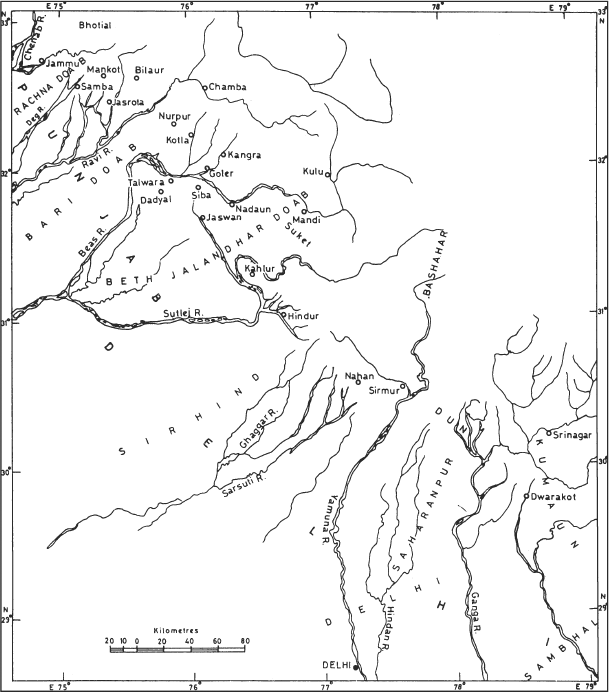
Imperial farmans, along with khil‘ats for the chiefs of Jasrota, Nurpur, Bilaur and Samba, directing them to mobilize their retainers for the suppression of the Sikhs, fell on deaf ears.107 Even when they were forced to come and join the campaign, their sympathy was with the Sikhs. In June 1711, after a severe defeat at the hands of the Mughals, Banda Bahadur entered a pass which led to the interior of the Jammu hills. Saiyid Azmatullah, the chief of Rajauri, and Dhrub Dev, the chief of Jammu, arrived at the northern end of the pass and sealed it. Subsequently, Muhammad Amin Khan, Rustam Dil Khan and Isa 5. Hill chieftaincies in and around the Khan, the Mughal generals, joined Punjab the chiefs. The arzdasht they sent to the emperor records their hope of capturing Banda within a day or two. But ironically the Sikh leader again eluded them and within a month, was reported to be somewhere in the Jammu hills.108 The chief (zamindar) and the people (khalaiqs) of Kahlur are mentioned as friends (rafiq) of Banda. On 6 April 1711, some Sikh outposts (chaukis) in the Kahlur hills were reported to have been established; immediately after this a Sikh emissary met the Kahlur chief and brought him a letter and some presents from Banda. The chief promised to give refuge to the Sikh leader whenever needed and block the entry of the Mughal army into the hills. The chief is also reported to have raised a big armed contingent for this purpose!109 Within a year, on 23 January, 1712, Banda was reported to have escaped from Kiratpur and plundered an Afghan village on his way to Kahlur. Chasing him, Muhammad Amin Khan occupied and devastated Kiratpur and Kalian which had hitherto been the strongholds of the Sikhs. As the chief of Kahlur gave little assistance to the Mughal general, he could not enter the hills and had to stop at the village of Nimona, about a mile north of Kiratpur.110 In Kahlur about 200 sawars and 5000 piyadas joined the Sikhs, a thana was set up at Bilaspur and then Banda moved to Belowal. A number of Sikh generals were deputed by Banda to encounter Hoshdar Khan, the faujdar of Doab Jalandhar, who was (p.162) camping at the village of Jhanjun in the territory of Jaswan about 30 miles north-west of Kahlur.111
Page 16 of 40
193Mughal Power, the Sikhs and Other Local Groups in the Punjab
However, the chief of Kulu and the chiefs (thakurs) of Jaswan and Hindur appear to have been among the few supporters of the Mughals in the hills. In his campaigns against the Sikhs, Hoshdar Khan seems to have been considerably assisted by the chief of Kulu. Since the chief of Kulu was a traditional enemy of the Sikhs and we have no evidence of any change in his attitude to them, it can be presumed that he consistently helped the Mughals against the Sikhs.112 The thakur of Jaswan initially not only helped Hoshdar Khan in setting up the Mughal military posts in his territory but also offered his services to guide the Mughals into the difficult passes of the hills of Kahlur. Hoshdar Khan recommended that the thakur be formally appointed a guide. But the emperor disapproved of the suggestion, evidently because of his apprehension of the double dealing of the thakur.113 This was not unfounded. According to one report even the thakurs of Jaswan and Hindur repented their support to the Mughals and expressed their desire to come to terms with the Sikhs.114
Apart from one Inayat, the zamindar of Talwan, and Sa‘adat Yar, the zamindar of Kotla (?), who are recorded as the allies of the Mughals, we have no evidence regarding the Punjab chieftains’ attitude towards the Sikh uprisings in the plains. The zamindar of Talwan seems to have been a close associate of Mahabat Khan, son of Mun‘im Khan, the wazir, and was once deputed to mobilize and escort the zamindars to the court to chastise the Sikhs.115 One Raja Bakhtawar, the zamindar of pargana Dadyal in sarkar Beth Jalandhar, however, is reported to (p.163) have given shelter to Banda in his territory. Later, the Raja died in an encounter against the amil of the pargana.116
It was with his tactfulness and statesmanship and the demonstration and use of force that Banda made the hill chiefs his allies. He also aspired to capitalize upon the discontent of Jai Singh and Ajit Singh over their fortunes under Bahadur Shah. The letter that some Sikh sardars namely, Bakht Singh, Bhagwan Singh, Jai Singh and Gaur Singh wrote to Raja Jai Singh allegedly in reply to the latter’s note to them shows how the Sikh leader endeavoured to mobilize the Rajput chiefs to his support.
But Banda’s individual manoeuvrings do not alone explain the chiefs’ role. With the Sikh movement the hill chiefs, who by themselves were unable to unite and evolve into a unified political power, saw the possibility of the emergence of an another political centre in the region. Even earlier at the time of their integration into the Mughal empire in Akbar’s reign, the chiefs had divided loyalties so long as there was more than one centre of political power.117 In this connection the difference in the attitude of the hill and the plain chiefs is to be particularly noted. The thakur of Jaswan and the zamindars of Talwan could not afford to make use of the Sikh movement as much as the hill chiefs could, since they did not have the advantage of the latter’s geographical position nor the benefits of an informal and loose integration of their territories into the imperial system. This is further illustrated from the fate of Raja Bakhtawar of pargana
Page 17 of 40
194Mughal Power, the Sikhs and Other Local Groups in the Punjab
Dadyal on the fringe of the hills who died fighting against the retainers of a mere amil of the pargana.
The Sikhs had not yet, however, emerged as the destroyers of Mughal power. Hence, evident vacillations in the attitudes of even some of the hill chiefs. They always tried to keep a door open to the Mughals. Some of them sent severed heads of dead Sikhs,118 apparently collected from battle-fields where the Mughals had fought against the Sikhs. Not a single living Sikh is reported to have ever been captured and sent to the court by any one of these chiefs, despite repeated imperial farmans to this effect. Some others despatched peshkash 119 in order (p.164) to reduce the impact of their constant failings in their obligation to the Mughal state, namely, military assistance in their respective territories. This was why they could still expect help from some eminent nobles, together with their open or secret support for the Sikhs. In November 1711, for instance, some officials of the Sirmur chieftancy approached Raja Jai Singh and Raja Ajit Singh to secure their recommendation for the release of their chief. The chief of Bilaur is also recorded to have written to them explaining his position and the Sikh ‘excesses’ in his territory. The rajas, however refused to intercede on their behalf, for, as they asserted, ‘without the connivance of the zamindars (of the hills) who could have entered the hills?’120
It may be noted that it was not only the chiefs but also the people (khalaiq) of some of the chieftaincies who extended their help to the Sikhs. Again, someof these chiefs and people seem to have acted in unison with the roving grain traders (banjaras) who took and sold foodgrains from the plains to the hills. In 1710, in the wake of Banda’s flight to the hills, the imperialists under Rustam Dil Khan and Firoz Khan Mewati had to encounter stiff resistance from the banjaras who had led the Sikhs through the difficult routes of the jungles. Later it was reported that the banjaras ravaged a number of the villages around.121 On 4 July 1715, the banjaras of Kangra carried weapons along with grain to the Sikh hideouts in the hills.122 Our sources do not give any explicit reason for the resistance of the hill peoples and the banjaras against the Mughals. There is a possibility that some people in the hills of Kahlur who have been mentioned in our sources as friends of the Sikhs and the roving bands of the grain traders were Jats. We may also presume that (p.165) the inflated rates of ijara leading to the exorbitant rise in the prices of foodgrains hit both the banjaras and the peoples in the hills.
The question of the support for Sikhs in the hills perhaps required more than a political answer. However, Bahadur Shah tried to tackle it at a politicoadministrative level. He took certain measures with a view to integrating the chiefs’ territories into the imperial administration more fully. On 21 November 1711 all the parganas on the edges of the Jammu and Kumaon hills held by the zamindars as their jagirs or in‘ams were ordered to be converted into khalisa while pargana Kashipur and four other adjacent mahals which had hitherto been
Page 18 of 40
195Mughal Power, the Sikhs and Other Local Groups in the Punjab
an in‘am of the Kumaon chief were given in jagir to Mahabat Khan. Within a few weeks, on 30 December, Inayatullah Khan was made the darogha of the mansabs, the jagirs and the in‘ams of the hill chiefs of the area extending from Jammu to Kumaon. Subsequently, the local officials’ suggestions either for an increase or decrease in the jagir or in‘am of a hill chief were to be examined first by Inayatullah Khan. It was only after his investigation into the formal approval of these suggestions that the relevant papers were to be presented before the emperor.123
These measures were meant to curtail and restrict the power of the chiefs, but they did not affect their concord with the Sikhs. The emperor therefore decided to march in person to the hills and on 26 January 1712, the officers who provided the details of the geography of the imperial highways (khushmanzils) were ordered to measure and report the distance and the stations between Lahore and Kangra.124 Simultaneously, Ghazanfar Khan, the qiladar-designate of Kangra, on the recommendation of Zulfiqar Khan who was in favour of a compromise with the Sikhs, was replaced by Fauj Ali Khan.125 The journey was, however, delayed and then it could not be taken due to the emperor’s illness and death in February 1712.
We cannot speculate as to what would have resulted with the emperor’s expedition to the hills. It may be noted that certain political (p.166) steps tilted the balance in favour of the Mughals in Farrukh Siyar’s reign. But before we examine them, we shall try to describe some of the factors which contributed to the Mughal failure against the Sikhs.
The Sikhs and Mughal Court Politics
At Lohgarh when the emperor and the wazir were ‘frantically striving to capture Banda and liquidate the seat of Sikh power, Zulfiqar Khan’, according to Kamwar Khan who was an eyewitness to the event, ‘set out at a leisurely pace and constantly tried to impress upon the emperor the advisability of marching slowly.’ This negligence and dilatoriness was in part due to Zulfiqar Khan’s dislike for and his quarrel with the wazir.126 In an another instance, Rustam Dil Khan had to retire from the Sikh campaigns in disgust because of the noncooperation of the fiscal officers. Rustam Dil Khan was one of the leading Mughal generals who had scored victories over Banda and earned the titles of Ghazi Khan Rustam Jang from Bahadur Shah for his services in the Sikh campaigns. By 1711, however, he seems to have been disgusted with the existing situation and on 21 August 1711, retired from the Sikh expedition. The prime reason for his withdrawal was the diwans’ reluctance to pay arrears (amounting to Rs 12,000) to him. Rustam Dil Khan’s protest was apparently justified, since the amount had formally been sanctioned. But the emperor showed no concern for his difficulty. He believed in the version given by Rustam Dil’s opponents, took his withdrawal from the expedition as an act of defiance and instead of commissioning an investigation into his grievances, issued orders for his
Page 19 of 40
196Mughal Power, the Sikhs and Other Local Groups in the Punjab
imprisonment in the fort of Lahore.127 The consequence of such hasty steps is perhaps better illustrated in a letter to the emperor from Muhammad Amin Khan, another important general. The letter which was received at the court within a few days of Rustam Dil Khan’s imprisonment included the details of Amin Khan’s failure in securing money from the local treasury for the payment to his soldiers.128
These incidents show the crippled control of the centre over the various departments of finance and local administration. This is further (p.167) illustrated from a number of other similar instances which we shall see later in Chapter 5. Banda had a considerable number of followers and sympathizers among the lower Mughal officials and among the associates and retainers of the nobles.129 This might have had an impact on the process. But the Sikh movement cannot be taken as the single most important factor leading to the decay in the local administration. As we have seen earlier, and shall also see later in the context of clashes amongst the big and small Mughal officials, the decay in administration continued perhaps with greater intensity after 1715. Bahadur Shah’s failure, despite his sincere efforts, in completely freeing the state from Aurangzeb’s discriminatory policies is perhaps a matter of considerable consequence in the examination of the sources of strength or weakness of both the Mughals and the Sikhs. Support for Banda’s cause was undoubtedly strong among the Jats, and some Hindu employees at the Mughal camp also sympathized with the Sikh movement. Nonetheless, it seems to have cut across caste and creed distinctions.130 This highlighted an alignment of certain interests in support of the Sikhs. But the imperial order to shave their beards discriminated against the Hindus alone. The order smacked of the emperor’s suspicion regarding the loyalty of the Hindus to the state. The Hindus appear to have received it with some resentment and anguish. Some nobles, like Sarfraz Khan, realized the implications of the order and tried to restrict its implementation to the Sikhs (Nanak parasts) only. But a fresh imperial order rejected the modification of Sarfaraz Khan and thereafter all Hindus with beards were denied entry to the court.131 Again, Aurangzeb’s policy of encouraging the conversion of the zamindars and thereafter taking it for granted that they were sincere supporters of the imperial (p.168) policy also seems to have been continued. On 31 August 1711, Mehr Chand and six other zamindars of the suburbs of Batala, a town in the stronghold of the Sikhs, accepted Islam after which each of them received khil‘at and in‘am from the emperor.132
These incidents explain, in a measure, the Mughal failure against the Sikhs. They show how Bahadur Shah under pressure of circumstances, had to abandon or rather reverse, the process of his departure from the policy of Aurangzeb. Towards the end of his reign, however, he had fully realized the consequences of these measures and had decided to finally dissociate the Mughal state from orthodoxy. The khutba episode at Lahore, which we have noticed in Chapter 1, probably marked the beginning of the new policy. And the death of the emperor,
Page 20 of 40
197Mughal Power, the Sikhs and Other Local Groups in the Punjab
too, could not disrupt its implementation. Again, it is not unlikely that Bahadur Shah had also realized, as is illustrated from the delay in the emperor’s plan to personally lead an expedition against the hill chiefs, the necessity of winning over the hill chiefs through the kind of gesture which he had shown the Kachhwahas and the Rathors in 1711.
The Mughal Rulers, the Hill Chiefs and the Sikhs: 1712–1714
A change in the general tenor of imperial policy is discernible immediately after the death of Bahadur Shah. The new Emperor, Jahandar Shah had governed Multan and thus had direct experience of the region. He had raised Isa Khan Mein, a zamindar of Jalandhar Doab, to a high position which indicated how much he valued the support of the local magnates, especially in the existing circumstances. His wazir Zulfiqar Khan, who was the real ruler in Jahandar Shah’s time also believed in, as it was reflected in his attitude towards the Marathas and the Sikhs, a policy of all possible adjustment with the local and regional potentates. Towards the hill chiefs therefore a kinder and more benign policy began to be pursued. Bhup Prakash, the chief of Sirmur, was released on bail and khil‘ats were despatched to the chiefs of Kumaon who professed friendship with the Mughals but had given them little support against the Sikhs.133 This benevolent attitude (p.169) together with some concrete administrative measures was maintained under Farrukh Siyar. The revenues of the territories of the hill chiefs seem to have been reassigned to the chiefs themselves or else they were resumed into khalisa.134
The policy had a perceptible bearing on the relations between the chiefs and the Sikhs. According to a newsletter of 2 October 1712, the Sikhs clashed with the retainers of Bhup Prakash in the Sirmur hills. The chief informed the Mughal general of the whereabouts of the Sikhs and guided him in his hunt for the Sikhs in the Kulu hills. He is also reported to have requested help from the Mughals for the Kulu chief against Sikh attacks. With the Sirmur chief won over by the Mughals, Banda began to lose his base in the Sirhind region from where the Sikhs could threaten inroads even into the Mughal capital. On 16 March 1713, therefore, the Sikhs invaded the country of Bhup Prakash with a huge army and the chief had to run away. But the Mughals at this stage were making special efforts to restore their full control over the region. They forced the Sikhs to retreat down to Dabar where again the Sikhs lost heavily at the hands of the imperial forces.135
The change in policy towards the chiefs had an important strategic dimension. The Mughals wanted to prevent the Sikhs from having any base in the hills east of the Shivalik. The chiefs’ support in these hills gave Banda an opportunity to strike at the Mughals over a very wide area, extending from the Jalandhar Doab in the Punjab to Bareilly in suba Delhi. In 1716, in the wake of celebrating a victory over Banda, a khil‘at was specially conferred on the Sirmur chief. Also for the same reason, favours were extended to the chief of Kumaon, the more so,
Page 21 of 40
198Mughal Power, the Sikhs and Other Local Groups in the Punjab
because the Srinagar-Garhwal chief in his neighbourhood was still a strong supporter of the Sikhs and the other rebels.136 As a result, the Kumaon chief rendered valuable service to the Mughals in arresting (p.170) the Sikh advance into this region. On 13 July 1715, a detachment of the retainers of the Kumaon chief was reported to have intercepted, and clashed with, a joint army of Banda and the Srinagar-Garhwal chief on the latter’s way to Moradabad and Bareilly.137
The Kumaon chief was encouraged to keep on containing and chastising the Srinagar-Garhwal chief, till the latter submitted unconditionally to the Mughals. Twice in the second year of Farrukh Siyar’s reign (between 25 July and 19 December 1713) the Kumaon chief sent him booty obtained in the battles against the combined forces of the Srinagar-Garhwal chief and his Jat and Gujar allies to whom he had given shelter in his territory.138 Early in 1715, the Kumaon chief, now honoured with the tide of Raja Bahadur, again fell upon Srinagar, finally disolodged the chief and took the town into his possession.139 The incident which was described in Mughal records as a victory of the Mughal Emperor, forced the vanquished chief to make entreaties to the Mughal court. In a letter to Raja Jai Singh giving details of his eviction from, and devastation in, his zamindari by the Kumaon chief, the Srinagar-Garhwal chief requested the raja’s intercession for his reinstatement. In the meanwhile, the Srinagar-Garhwal chief also assisted Saiyid Najm-ud-Din Ali Khan Barha against the rebel Gujars.140
(p.171) By the end of 1714, the Sikhs seem to have been almost totally isolated from the hill chiefs. During the last phase of his struggle, Banda Bahadur was cornered, his resistance of the Mughals was confined to Gurdaspur and its neighbourhood in Bari Doab. Even in this area, the chiefs of Kangra and Nurpur and some others had turned their back against the Sikhs. In the beginning of 1715 the Nurpur chief invaded the Sikh fort. In June 1715 imperial farmans to the chiefs of Kangra and Nurpur and to some other hill chiefs were considered sufficient for the blockage of the banjaras in the hill passages.141 The Mughals could now also deal with some of their persistent foes in the hills with uncompromising sternness.142
The chiefs with a few exceptions were reconciled through leniency and generosity and also through, whenever it was necessary, tough and ruthless measures. The army of Abd us-Samad Khan which eventually stifled the Sikh power in 1715, consisted of the chieftains and thousands of their retainers.143
Position of the Khatris in Mughal Service after 1712
A significant feature of the change in the general tenor of the policy of the Mughals after the death of Bahadur Shah was their conscious attempt at making use of the gradual alienation of the Khatris from Banda’s movement. The Khatris obtained high positions under Jahandar Shah and Farrukh Siyar. Sabha Chand, a mere munshi of Zulfiqar Khan, (p.172) for example, obtained the title of raja
Page 22 of 40
199Mughal Power, the Sikhs and Other Local Groups in the Punjab
from Jahandar Shah and rose to the office of the diwan-i khalisa.144 Sabha Chand was a close associate of Zulfiqar Khan and the treatment that Zulfiqar Khan’s friends and associates received from Farrukh Siyar need not be repeated here.145 Sabha Chand, was handed over to Mir Jumla (24 June 1713) and within a week the tongue of the ill-fated diwan was cut off on the grounds of his using false languge. Saiyid Abdullah Khan, however, seems to have realized the implications of any drastic punishment against Sabha Chand and therefore either under the influence and pressure of his diwan, Raja Ratan Chand, or owing to his own enlightened policy, pleaded and eventually secured his release. The fact that Sabha Chand’s release came after a year and coincided with Abdus-Samad Khan’s departure for the chastisement of the Sikhs is not without significance.146 Although Sabha Chand was not reinstated to his earlier position, his son Kunwar Har Sevak who died in April 1735, is mentioned by a contemporary historian as one of the ‘notables of the time’.147
Ratan Chand, who came from a trading community and Muhkam Singh Khatri both began their careers as munshi and diwan in the sarkars of Saiyid Abdullah Khan and Saiyid Husain Ali Khan respectively. Ratan Chand acquired the reputation of being the ‘key of wisdom’ (kalid-i aql) of the Saiyid brothers while Muhkam Singh who was simply a mutasaddi in chakla Bareilly received the title of raja and was promoted to 3000/2000 under Farrukh Siyar. Later, in the beginning of the reign of Muhammad Shah, he rose to the rank of 7000 zat.148
On 20 November 1711, during the reign of Bahadur Shah, Bakht Mal, an associate, and a diwan in the sarkar of Muhammad Yar Khan149 was imprisoned and handed over to lhtimam Khan for his alleged sympathy and support for the Sikhs. We know nothing about him till (p.173) the end of the seventh year of Farrukh Siyar’s reign (February 1717 to February 1718), when on the recommendation of Saiyid Abdullah Khan he rose to 2000/200 and replaced Inayatullah Khan as the diwan-i tan.150 A substantial number of Khatris, as the following table shows, acquired such an eminent position in Mughal service or otherwise that they have been mentioned by a contemporary chronicler among the nobles (umara) and notables (a‘yan).
Besides, a number of Khatris in the category of peshkars in the office of diwan-i tan-o-khalisa and as minor officials are mentioned in our sources. Kamwar mentions Kirpa Ram, Dina Nath and Jagat Ram as peshkars of the tan in the reign of Muhammad Shah; Rai Phul Chand, Jaswant Rai and Bishwa Nath are described as peshkars of the khalisa, and mustaufi (auditor) respectively while Qabil Ram was in charge of records relating to the dignities and honours of the nobles (maratib nawis).151 Anand Ram ‘Mukhlis’ describes a number of his relations, e.g., Kirpa Ram, Fateh Singh and Basant Ram as being associated with various departments of the office of the diwan.152
Page 23 of 40
200Mughal Power, the Sikhs and Other Local Groups in the Punjab
Name Position Year of death Source diwan of Abd-us-Samad 1 Pandi Mai Gandhi 1722 T. Muhammadi, p. 46. Khan 2 Rai Rayan Muhkam Singh a notabie 1725 T. Muhammadi, p. 55. 3 Raja Hirday Ram vakil of Amin Khan, 1724 T. Muhammadi, p. 57; Sarbuland Khan and the Safarnama, p. 9. other nobles, 2000/500 4 Raja Daya Ram vakil of Qamar-ud-Din 1726 T. Muhammadi, p. 60; Khan Kamwar, f. 373 b. vakil of Amin-ud-Daulah 5 Har Sahai 1726 T. Muhammadi, p. 60. and Saiyid Hasan Khan 6 Ikhlas Khan (an oil a noble 1727 T. Muhammadi, p. 65; Majmaun-Nafais, f. 499a; merchant and convert) Fathiya Asafiya, f. 89a. 7 Raja Raghunath amin and faujdar of chakla 1729 T. Muhammadi, p. 70. Sirhind, 2000/500 amin and faujdar of chakla 8 Raja Mansukh Ram 1731 T. Muhammadi, p. 80. Bareilly 9 Rai Rayan Majlis Rai amin and faujdar of Batala 1733 T. Muhammadi, p. 85; Safarnama, p. 92. T. Muhammadi, p. 87; 10 Rai Sahib Singh a notable 1733 Badai, f. 58b.
Page 24 of 40
201Mughal Power, the Sikhs and Other Local Groups in the Punjab
Name Position Year of death Source 11 Raja Jaswant Singh Khatri a notable 1733 T. Muhammadi, p. 87. 12 Raja Lachhi Ram a noble, 2000/500 1734 T. Muhammadi, p. 88; Kamwar, p.376b. 13 Raja Muhkam Singh a noble, 7000 zat 1734 T. Muhammadi, p.89; m. u., II, pp. 330–2; Kamwar, ff. 342b, 347a and 373b. 14 Kuwar Har Sewak a notable 1735 T. Muhammadi, p. 92. 15 Shaikh Sa‘adatmand vakil of Nizam-ul-Mulk 1735 T. Muhammadi, p. 94; Kamwar, f. 381a. vakil of the governor of 16 Balkishan 1736 T. Muhammadi, p. 96. Bengal 17 Mehta Sadanand faujdar of Etawah 1735 T. Muhammadi, p. 94. 18 Raja Bakht Mal a noble, diwan-i khalisa 1738 T. Muhammadi, p. 100; T. Muzaffari, f. 83a. 19 Raja Sambhu Ram a notable 1739 T. Muhammadi, p.106. 20 Rao Kashi Ram a notable 1739 T. Muhammadi, p. 106. 21 Rai Naunidh a notable 1739 T. Muhammadi, p. 112; Kamwar, f. 376a. 22 Rao Babu Rai a notable 1739 T. Muhammadi, p. 113.
Page 25 of 40
202Mughal Power, the Sikhs and Other Local Groups in the Punjab
Name Position Year of death Source deputy faujdar of T. Muhammadi, p. 117; T. 23 Rao Harnand 1741 Moradabad Muzaffari, f. 101b; M. U., II, p. 841; Safarnama, p. 55. 24 Shaikh Sa‘dullah Khatri a noble, diwan-i tan 1744 T. Muhammadi, p. 122; Kamwar, p. 337; Safarnama, p. 57. 25 Raja Dhirendar a notable, diwan of Amir 1747 T. Muhammadi, p. 137. Khan faujdar of Panipat 26 Bhupat Rai Kamwar, f. 376a.
Page 26 of 40
203Mughal Power, the Sikhs and Other Local Groups in the Punjab
(p.174) (p.175) These Khatris, though we have no evidence for all of them, appear to have originally belonged to the province of the Punjab, for the Punjab is mentioned as the homeland of those Khatris about whom we can gather some biographical details. Ikhlas Khan hailed from Kalanaur and Hirday Ram, Daya Ram, Har Sahai and Majlis Rai belonged to Sodhra, pargana town in Rachna Doab.153 Again some of the other Khatris whom we have not listed here, e.g., Atma Ram, the diwan of Awadh and his sons, also came from the Punjab. Though most of them were not very highly placed in the traditional hierarchy of Mughal officials, they acquired eminence mainly due to their close relations with big merchants and sahukars and have been characterized in our sources among the a‘yan. Notwithstanding their official position, they seem to have retained their ancestral professions and were thus in command of considerable wealth and prestige.154 It was through the efforts of Gajpat Rai that Khwaja Muhammad Qasim (Samsam-ud-Daulah’s (p.176) father) could obtain a high mansab and honour. Again, it was Gajpat Rai who managed his marriage to the daughter of Ruhullah Khan. Raja Hirday Ram is reported to have secured for Samsam-ud- Daulah the governorship of Gujarat and an amount of Rs 50,000 from the court. In 1720 after the death of Saiyid Husain Ali Khan, Emperor Muhammad Shah handed his personal ring to Raja Daya Ram and deputed him to go to Ratan Chand and persuade the latter to submit to the court.155 Again, the aristocratic establishments of these Khatris, in spite of the fact that they were apparently mere agents and clerks of the Mughal nobles, speak of their wealth and rich possessions. They seem to have maintained, for instance, one or two elephants and camels, a number of horses of different breeds, karkhanas and servants to look after their establishments.156 This probably partly explains the emergence of the Khatris as vakils of the nobles in Mughal India, for the prime responsibility of the vakil was to keep the economic position of their clients on secure footing. The working of the institution of the vakil and the nobles’ trust in, and their sole dependence upon the Khatris also show the nature of the relationship between these two important social groups of Mughal times.
The increase in strength of the Khatris, an important trading community of northern India, in imperial service may probably be viewed against the background of the fact that the fortunes of the merchants in Mughal India were closely tied with the prosperity of the nobles.157 The financial difficulties of the nobles must have affected the prospects of trade as well.158 Subsequently, the merchants began to seek some (p.177) new avenues to build their fortunes which might also have led to their increased political participation. Again, they had to defend the existing political framework in the face of the agrarian uprisings. Their donations to the imperial treasury to finance the campaigns against the Sikhs may also be considered in this light.
Page 27 of 40
204Mughal Power, the Sikhs and Other Local Groups in the Punjab
With the ascendancy to power of Zulfiqar Khan and, following him, the Saiyid brothers, the Mughal state’s association with orthodoxy came to a final end. The Sikh menace under the leadership of Banda continued till 1715, but the discriminatory measures to meet the challenge such as the shaving-off of beards by the Hindus alone were not repeated after the commencement of jahandar Shah’s reign. Further, the Mughals tried to widen, and make full use of, the differences among the various sects of the Sikhs. According to Macauliffe, the Sikhs had already been divided into two groups, Jat Khalsa (real Sikhs) and Bandai Khalsa (followers of Banda). When Banda assumed royal ensignia and claimed to be the Guru, the Jat Khalsa refused to recognize him as the true Singh and accused him of having disregarded and violated the Guru’s commandments. Farrukh Siyar took advantage of the rift and utilized the influence of Gobind Singh’s widow to isolate Banda from the Sikhs.159 On 16 August 1715, Guru Gobind’s son was honoured with a khil‘at-i matami on the pretext of the death of the Guru.160 It cannot be ruled out that the khil‘al-i matami bestowed on the son of the Guru about five years after the death of the Guru signified the extension of official patronage to those who could possibly be pitted against Banda.
The changes in Mughal policy coupled with some weaknesses in the Sikh movement itself gave it a serious jolt. Banda along with 700 followers was captured and put to death in Delhi in 1715.