
Abstract and Keywords
This chapter examines the political and administrative developments in Punjab after 1715 in relation to the changing economic scenario. It highlights the change in the nature of the Sikh movement from one of relatively strong peasantry for raising themselves socially in the seventeenth and the earlyeighteenth century to the one of impoverished zamindars and peasants struggling for survival and maintenance of their existing positions in the eighteenth century. The jama figures had plummeted in Punjab from the later years of Aurangzeb’s reign. This shortage had been overcome by the prosperous trade with West and Central Asian countries. However, due to political disturbances these trade routes suffered in the years after 1715 leading to degradation of Punjab’s economy and shortages for zamindars and peasants. The Sikh movement regrouped in the period after Banda and kept posing challenges to Mughal administration. The hill chiefs too asserted their authority in their localities. As the Mughals failed to contain the Sikhs and the zamindars, their uprisings succeeded in dispelling the fear of Mughal power. Unlike Awadh where the governors worked towards an alliance with the local potentates and ensured stability, the governors of Punjab tried to quell the dissent but failed in their attempts. Also, the jagir administration developed further cracks when the subadar contested the claims of the provincial diwan to assert their authority. As crisis enveloped the region and the threat to the Mughal power increased from the peasants, the Mughals grew more dependent on the Khatris and the other trading communities.
Page 1 of 26
217The Punjab after 1715, the Zamindars and the Problems Facing the Provincial
Government
Keywords: Mughal empire, imperial power, political developments, Sikh movement, zamindars,
peasants, uprisings, merchants, trade routes, jama, Khatris
POLITICAL AND ADMINISTRATIVE DEVELOPMENTS in Awadh and the Punjab until the beginning of the 1720s were, in a large measure, similar. The governors of both these provinces struggled for additional powers which they obtained eventually, to enable them to meet the threat from local conditions. Rural disturbances together with conflicts in the province at various levels and the steady erosion of the classical pattern of the relationship between the emperor and the nobility with its consequent stormy politics at the court, influenced the course of change in the position of the governors. With the beginning of the third phase of the period of our study, however, when the process of provincial independence from the imperial centre set in, these provinces took different directions. This difference had a bearing principally on the development, as in Awadh, or the lack of development, as in the Punjab, of what have been called ‘successor states’.
The period from 1715 until the formation of the misls in the mid-eighteenth century is perhaps the least known and most confused chapter in the history of the Sikhs in the eighteenth century. ‘The few remaining Sikhs’, as a lateeighteenth century observer puts it, ‘fled to the mountains after the execution of Banda in Delhi where they concealed themselves; and the zamindars and riots of the country who (p.179) had joined them during their insurrection, partly to secure themselves, and partly for the sake of plunder, now cut off their beards and hair, and returned to their original occupations’.1 This statement needs qualification, for we have instances of the same kind of plunder and banditry as before by the Sikhs or their supporters, even though Abd-us-Samad Khan tried to reconcile a section of the Sikhs (Tatva Khalsa). On 24 September 1717, goods and valuables of traders and travellers were reported to have been plundered in the suburbs of Lahore. As the amil had a very small armed contingent, he could not provide protection to them.2 The entire trade-route which passed through the province of the Punjab, seems to have been disturbed. About two months after, in another case, six merchants were killed and their belongings were looted at the village of Aurangpur on their way from Lahore to Delhi.3 Our sources ascribe these incidents to the mufsids and maqahir (the seditious and the vanquished ones), a generic term to denote ‘the disturbers’, ‘seditious elements’, namely, rebels in Mughal times. But a close scrutiny of the nature of these ‘disturbances’ which had a striking resemblance with the earlier Sikh and zamindar attacks on the trade caravans lead us to identify the mufsids with the Sikhs. Besides, the term maqahir in our sources has generally been used for the Sikhs.
Following the death of Banda the Sikhs reorganized themselves and concentrated on increasing their strength and maintaining unity in their ranks.4 This seems to have been accomplished around the early 1720s. With better
Page 2 of 26
218The Punjab after 1715, the Zamindars and the Problems Facing the Provincial
Government
organization and enhanced striking power, they then began to attack contingents of Mughal officials. In 1721, they made a successful night-assault on a Mughal detachment under Ruh-ul-Amin Khan in pargana Pasrur.5 In 1726, they plundered an imperial caravan and killed some Mughal officials somewhere between Lahore and Sirhind.6 The Sikhs and their supporters continued to pose (p.180) dangers to the government of Zakariya Khan (1726–45) in the late 1720s and the 1730s.7
In 1733, Zakariya Khan reportedly extended concessions to some Sikh leaders. Kapur Singh, for instance was given jagirs and the title of nawab. The Sikh leaders, now settled in Amritsar, used this opportunity to organize their community, as the tradition goes, under Budha Dal (old party) and Tarun Dal (young party), each divided into five units (deras). But even before the invasion of Nadir Shah, the jagirs of the Sikh Sardars were confiscated and a large number of the Sikhs were forced to take shelter in the hills and the Lakhi jungles.8 For a period of five months in 1739–40 during which Nadir Shah was in India, the Punjab and the areas in its neighbourhood were thrown into great confusion. The Sikhs took advantage of this confused and helpless state. ‘They established themselves in the Bari Doab under the leadership of Bhag Singh Ahluwalia. They stopped traffic, plundered and raided a large number of villages and towns and exacted heavy tribute from the neighbouring zamindars. Jassa Singh Ahluwalia, the son of Bhag Singh’s sister, was his deputy and exercised full authority over matters and things concerning Bhag Singh. The other Sikh chiefs also accepted the leadership of Ahluwalia and willingly worked under him. The administration of the whole Doab thus seemed, at the time, to be passing into the hands of the Sikhs.’9 In 1743 they killed the official in charge of the escort (badraqa) and plundered the treasury on its way from Emanabad to Lahore. Azimullah Khan was sent to chastise the Sikhs and he succeeded, but his success seems to have been short-lived. Zakariya Khan, therefore, deputed Adina Beg to make the Sikhs submit. ‘The force he had with him was fully equal to the execution of that service, but Adina Beg, considering that if he should entirely put an end to all disturbances in that district, there would remain no necessity for continuing him in so extensive a command, carried on intrigues with the chiefs of the Sicks [Sikhs], and secretly encouraged them to continue (p.181) their depredation, at the same time, pretending to be very desirous of subduing them. From this management, the Sicks became daily more powerful and seized upon several places in the distant parts of the Subah of Lahore. They also began again to perform public pilgrimage to the Holy Tank at Amritsar, without molestation.’10
Towards the end of his life, Zakariya Khan again tried to win over the Sikhs through his diwans, Lakhpat Rai and Jaspat Rai. They were encouraged to settle and improve on agriculture. Earlier, the governor took measures to rehabilitate the economy of the province following the Persian invasion. Soon, however, Zakariya Khan died, and the subsequent civil war between his sons again gave
Page 3 of 26
219The Punjab after 1715, the Zamindars and the Problems Facing the Provincial
Government
the Sikhs an opportunity to organize themselves through successful raids and plunders. ‘Bodies of armed men in tens and twenties called Dharwee in the dialect of the province, that is highwaymen, infested the routes of communication, attacked villages or plundered towns….’11 During these troubles, ‘the Sick chiefs Jassa Singh Kalal and Chrisa Singh, and Kirwar Singh, had got together about 5000 horses which army they gave the title of Dul Khalsa Gee, or the Army of the State and with which they made themselves masters of the Doab of Bary. Moin-ul-Mullock [Muin-ul-Mulk, the governor then] again appointed Adina Beg Khan to the Faujdary of that Doab, who marching thither, began as formerly to intrigue with the Sicks and took no effectual means to suppress them.’12
The Dal Khalsa organization changed the character of the Sikh resistance, enabling them to moblize a multitude of plunderers into some sort of rude cavalry regiments. The organization formed the basis of coming together of the different (according to a tradition 65) groups under eleven leaders in 1748 with Jassa Singh in supreme command. These armed bands of the eleven leaders together with those of the Phulkian states (Patiala, Nabha, Jind, etc.) of the cis- Sutlej region came to be known as the twelve misls in the eighteenth century.13 In the period between 1746 and 1748 the Sikhs also built the fort of Ram Raumi (p.182) at Amritsar (30 March 1747); this marked the rise of Amritsar as an important centre of political and military activities. Thus, by the end of our period the Sikhs were again organized, but this time principally as a band of bandits and plunderers, to wage a joint and effective resistance against the state. Their unity was strengthened by their gatherings (sarbat Khalsa) on the occasions of Baisakhi and Diwali at Amritsar where they passed resolutions (gurmattas) to guide their actions. These resolutions also made them realize that obedience to their leaders was a religious duty, a commandment of the Guru, imposed upon them by the community (panth) in whose body the Guru had merged his personality.
The revival of the Sikh challenge can in part be explained in terms of administrative failure. According to Henry Prinsep ‘the early neglect of the ruling authority enabled the associations to prosper, and the most successful chiefs purchased horses with the proceeds of their spoils and mounted and armed their followers.’14 One can extend it further by adding that the death of Zakariya Khan in 1745 and the subsequent civil war between his sons also enervated the Mughals against the Sikhs. We have also noted that some Mughal officials like Adina Beg made secret deals with the Sikhs in order to promote their own interests.
But the administrative failure also needs to be explained, particularly when we know that Zakariya Khan was an able and efficient administrator and that more than once he tried to reconcile with the Sikh chiefs. It appears as if arrangements with the leaders was of no use as the rank and file had a great
Page 4 of 26
220The Punjab after 1715, the Zamindars and the Problems Facing the Provincial
Government
deal of influence on them and compelled them, after the 1720s to take certain lines of action.
(p.183) The change in the nature of the Sikh movement from one of relatively strong peasantry for raising themselves socially in the seventeenth and the early-eighteenth century to the one of impoverished zamindars and peasants struggling for survival and maintenance of their existing positions in the eighteenth century can only be appreciated in the light of the history of the economy of the region. While the Punjab registered unprecedented growth in the seventeenth century, its economy seems to have suffered some setbacks since the last years of Aurangzeb’s reign. The silting of the Indus affected its riverine trade.15 This is also reflected, in a measure, in some of the available jama figures of the province for the seventeenth century. The increase in the jama in the first half of the century was spectacular, rising steadily from 55,94,58,423 dams at the time of the compilation of the Ain (1595) to 1,08,97,59,776 in 1658. On the contrary, in the second half of the century, the jama fell to 89,30,39,039 dams in the 41st year of Aurangzeb’s reign and after that the increase was very slow and nominal.16 We should not, however, hasten to characterize the economy of the region as stagnant on the basis of the jama figures for only a few years of a century. We may also note that trading centres like Gujarat, Wazirabad, Sialkot, Eminabad, Lahore, Sultanpur, Nakodar and Phillaur, and the richer soil areas of the Punjab concentrated around the great land route linking the Mughal empire with the land of the Safavids and the Central Asian Khanates. We can legitimately speculate that the seventeenth century trade on this route made up for the losses accruing from the silting Indus. In the late-seventeenth century Sujan Rai boastfully listed the Punjab among the richest provinces of the Mughal empire.17 Even as late as the 1720s, a biographer of Abd-us-Samad Khan described the Punjab in glowing terms, giving no indication of a province engulfed by a crisis.18 In the early-eighteenth century the villages around Batala and Kalanaur were producing enough surplus to feed the armed Sikh bands under Banda.19 (p.184)
(p.185) In the eighteenth
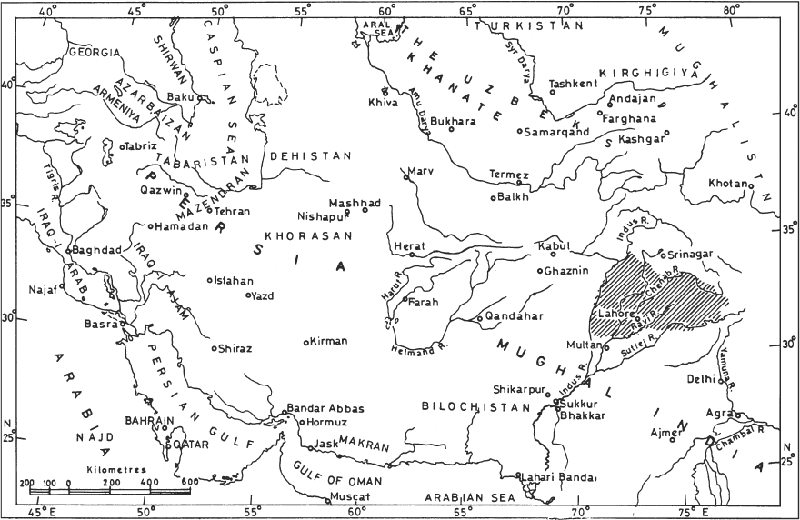
century, however, trade of the Punjab and the other parts of Mughal empire with Central and West Asian countries received a serious setback. The Ghilzai risings under Mir Wais in Qandahar in 1709 disturbed even the land route which connected our region with Persia. The early-eighteenth 6. The Punjab’s overland trade area century also witnessed the rapid decay of the Safavid
Page 5 of 26
221The Punjab after 1715, the Zamindars and the Problems Facing the Provincial
Government
empire, leading eventually to the capture of Isfahan by Mahmud Ghilzai in 1722. Later, Nadir Afshar, a general of the Safavid Shah, averted the danger of the Safavid Persia falling apart into the hands of the Russians, the Ottomans and the Afghans; but the country north-west of our region was never stable through the end of the period of our study.20
All this seems to have dislocated the economy of the Punjab. The hasil of the province fell from Rs 2,00,35,791/8¼ in the seventeenth century to Rs 1,25,18,182/9¼ in Muhammad Shah’s reign. The decline was the heaviest (from Rs 7,58,957 to Rs 1,98,328/14¼) in the income from the sair mahals of khalisa. The revenues of sarkar Multan including the city of Multan also declined heavily.21 Such being the condition, a large number of the tribal and the pastoral communities who had settled in and around the rich areas of the Punjab,21a may then have felt the brunt of the decline, and of these the poor peasants and halfsettled tillers would have been the worst sufferers. The Sikh movement in the eighteenth century seems to have lived on these pauperized sections. No arrangement with their individual leaders could have been effective, for even as the leaders organized them for joint and united actions, they had to make evident concessions to the demands of those most affected. All participated in the deliberations to pass the resolutions, the Guru responded not to the leaders but to the entire community. In the face of the steady decline of revenues and the constant threat and finally the invasion from the north-west, it was not possible for Zakariya Khan to resolve the Sikh problem, for it was not rooted in factors or policies under his control.
(p.186) The merchants and the traders perhaps appreciated the reasons for the malaise. They continued their association with the state, and in the face of the decline of trade, their strength in government service may well have increased. Indeed, the Mughals seem to have ruled the Punjab in our period through eminent Khatris, like Jaspat Rai, Lakhpat Rai and Kauramal. But the gap between them and the Sikhs and the other agrarian communities steadily became unbridgeable. Apart from the trading caravans, the towns still seem to have been the principal targets of the dislocated communities. Possibly as a measure of defence against them, Batala was fortified in Muhammad Shah’s reign.22 A large number of the traders seem to have migrated from their hometowns in northern and western Punjab to the east and to the south of Multan in Sindh.23
In this context it becomes meaningful to note that besides the Sikhs almost all the zamindari risings in post-1715 Punjab concentrated on and around the great route or its branches. The zamindars posed a threat to the imperial power even after the Mughals had demonstrated their might forcefully by executing Banda and his comrades. On 26 July 1716, Qatil, a zamindar in pargana Gujarat was reported to have built a strong mud fortress near the qasba of Jakobar(?). He mobilized the zamindars of the entire pargana against the Mughals. No amil of
Page 6 of 26
222The Punjab after 1715, the Zamindars and the Problems Facing the Provincial
Government
the jagirdar was in a position to enforce imperial regulations and realize revenue from the villages.24 The Mughal jagirdar and amil could not realize a single penny from the Awan zamindars along the southern fringes of the route in Sindh Sagar Doab.25 The Salharia zamindars were up in arms against the Mughals in a number of khalisa and jagir villages in and around the pargana of Sialkot in Rachna Doab.26 In an instance from Bari Doab, the zamindars of tappa Sarhani, Naushahra and pargana Haibatpur patti along with 500 sawars and piyadas were reported to have invaded and devastated a number of villages in (p.187) pargana Fathabad. Many were killed while many others were wounded in their encounter against the invaders. The rest managed to escape in different directions.27 In an another instance in 1718, the Khokhar zamindars invaded the villages of Sadiqabad and Khalilpur, a ta‘alluqa of one Khwaja Muhammad Sadiq and dislodged the muqaddams of the villages.28 In an another case from Jalandhar Doab, the amil of pargana Rahon is reported to have died in 1722 in the encounter with the rustic villagers (ganwars) of the pargana.29 The road from Lahore to Multan also seems to have been vulnerable against the zamindar raids.30
In the late 1720s and early 1730s, almost the entire upper northern tract in the Chanhat, Rachna and Bari Doabs seems to have been disturbed by zamindar risings. A large part of the area between Hasan Abdal and the Ravi was under the control of Panah, a powerful leader of the Bhattis, while in the region between Lahore and the Sutlej Mir Mar often took to loot and plunder. Two major campaigns against these zamindars were led in person by the governor of the Punjab. Moreover, in 1734, the emperor is reported to have ceremoniously sent off the governor to chastise Mian Khan, a rebel zamindar of the province.31
(p.188) As the Mughals failed to contain the Sikhs and the zamindars, their uprisings succeeded, to a very large extent, in dispelling the fear of the Mughal sword. They demolished ‘the impenetrable wall that represented the majestic awe.’ In consequence, the whole province became disturbed and the hill chiefs now showed scant regard for the Mughal crown.