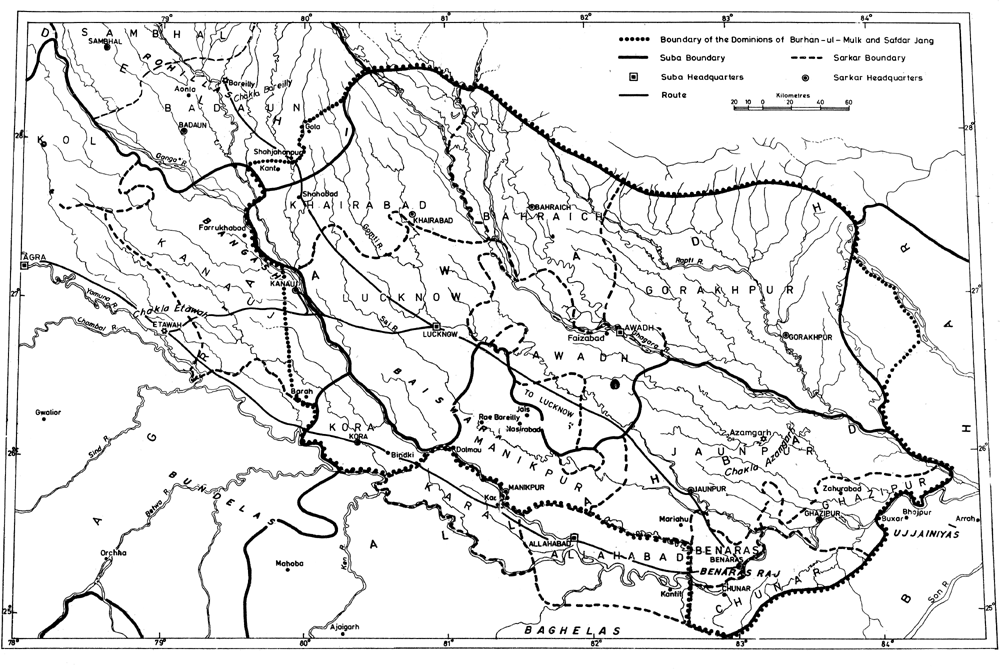
281The New Subadar and the Regions around Awadh Growth in the regions around Awadh, like developments within the province, also lent strength to the process of the new subadari. Eighteenth-century regional powers under the Rohillas (in the Moradabad-Bareilly region), the Bangash (in Farrukhabad) and the local zamindar (in the Benaras region) on the north-west, south-west and the south-eastern borders of Awadh indicated the economic stability of the areas in the neighbourhood of the suba. Evidence of the availability of considerable sums of money with the zamindars and in the villages is significant. In 1714, Madar Singh, a zamindar of the Moradabad-Bareilly region paid over Rs 52,000 to his Afghan soldiers out of the cash and valuables he had plundered from the villages in pargana Anola in Moradabad.9 In 1712 when Farrukh Siyar (1712–19) needed money, on his way from Patna to Agra, to avenge the death of his father and contest the throne against Jahandar Shah, he was able to appropriate Rs 100,000 from a Benaras zamindar in addition to what he obtained from a sahukar in the city.10
One indication of the prosperity of these regions was their brisk trade. A very large number of banjaras carried items of trade between Bihar and (p.250) Awadh in the 1730s.11 Valuables and merchandise of the banjaras worth Rs 400,000 were reported to have been among the goods plundered by the zamindar of pargana Rajpur in Moradabad in 1715.12 Developments in the Benaras raj region which included a large part of the four eastern sarkars, namely, Jaunpur, Ghazipur, Chunar and Benaras of suba Allahabad in the lateseventeenth and early-eighteenth centuries are to be particularly noted in this connection. At least three large market centres for local products, namely
Page 4 of 52
282The Imperial Court, the New Subadars and the Region
Azamgarh, Bhadohi and Mirzapur, came into existence and occupied an important place in the region during this period.13
The area under the modern district of Azamgarh which formed part of the Mughal pargana of Nizamabad seems to have witnessed a considerable increase in cultivation from the time of Jahangir (1605–26). Jahangir is reported to have awarded zamindaris to the Gautam Rajputs of the region. He encouraged them to settle in the area and build habitats and villages for the cultivators. Subsequently a number of Gautam Rajput villages and zamindari settlements came up. By the beginning of Aurangzeb’s reign (1657–1707), the Gautams of pargana Nizamabad were strong enough to command armed contingents, artillery and a large number of elephants and horses. Some time during the last years of the seventeenth century, the chief of the Gautams, Bikramajit Singh, had to become a Muslim to avoid execution at Aurangzeb’s order for (p.251) a conspiracy the chief had hatched to kill his brother, Rudra Singh. Aurangzeb’s order followed an appeal from the widow of the deceased. On conversion to Islam, Bikramajit Singh married, as the tradition goes, a Mughal woman in Delhi who bore him twosons, Muhammad Azam Khan and Muhammad Azmat Khan. Subsequently when after the death of Bikramajit, Azam Khan succeeded him as the chief of the Gautams, he founded the town of Azamgarh after his own name while his brother, Azmat Khan founded another town, Azmatgarh:14
By 1720, Azamgarh had grown into an important administration trative centre (chakla), next only to Jaunpur in the area. Azam Khan is also reported to have cut out a canal connecting the river Tons with the Kol.15 In the early decades of the eighteenth century, a number of bazaars and ganjs were founded by the successors of Azam Khan and Azmat Khan. At almost the same time when Mahabat Khan, a son of Azmat Khan, revolted against the Mughals, Azmat Khan’s other son, Babu Iradat Khan, built a bazaar in Kopaganj. In addition, ‘in a number of places Iradat Khan founded a ganj after his own name’. All of these ganjs survived till the middle of the nineteenth century.16 Subsequently at least five more ganjs and a zamindari centre with a fortress were built by the members of these neo-Muslim Rajput zamindars. Iradat Khan’s son, Jahan Khan built Mehrajganj, Jahanaganj and Shahgarh while his cousins, Babu Sufi Bahadur, Babu Husain Khan and Babu Jahangir Khan founded Sufiganj, Husainganj and Jahangirganj named after themselves.17
The growth of Azamgarh into a chakla headquarters together with the founding of these ganjs or grain markets must have followed a substantial increase in commercialized agriculture and the prosperity of the zamindars.
(p.252) Bhadohi was another important town in the Benaras region which came into prominence in the early-eighteenth century. Around Bhadohi too, successive village settlements began to grow from the time of Jahangir. We have found references to no less than twelve villages having come up in the
Page 5 of 52
283The Imperial Court, the New Subadars and the Region
immediate vicinity of the town from a quick survey of an early-nineteenth century local history. This history, it may be noted, was purportedly written to highlight, and establish the claims to, the powers and properties of just one family of the town.18 A number of mohallas are mentioned as having been settled and inhabited by the immigrants from outside during the seventeenth century. Some members of a qanungo of Kara for example, who had earlier migrated to Jaunpur came and settled in Bhadohi in Shahjahan’s time. The same years saw the rise of a mohalla inhabited by the Faruqi Shaikhs of Mandiaon. Towards the end of Aurangzeb’s reign, the Malik family of Rampur came in and founded mohalla Malikana.19 At least four important bazaars of the town, namely bazaar Salabat Khan, bazaar Rustam Khan, bazaar Ahmadganj and Katra Rusukhiat Khan, were founded during the twenty-five years between 1712 and 1737.20
The growth of Mirzapur in the late-seventeenth century with its central position, second only to the city of Benaras, in the economy of the region during the eighteenth and early-nineteenth centuries further shows the wealth of the region. We know very little of the antecedents of the founding of the town. But the little available information does suggest that the hinterland of Mirzapur responded to the demands of regional and perhaps also of long-distance trade. According to the Tarikh-i-Bhadohin, one Mirza Abd ul-Baqi Beg was sent to the area some time in the last years of Aurangzeb (when the emperor was in the Deccan) to deal with the refractory zamindars of pargana Kantit. The Mirza was welcomed by the Omars, a local merchant community and they appear to have assisted him in his campaigns against the zamindars. Subsequently, following the emperor’s order, the chief of the Omar community, Nand Lal Omar, founded a town on the bank (p.253) of the Ganga and named it after the Mirza. Soon after, Mirzapur was linked to the trade between the region and beyond through Mandvi Phulpur and Benaras. By the time of Muhammad Shah, Mirzapur had grown into a major town with a large katra in its centre and at least three ganjs, Muzaffarganj, Lalganj and Munnuganj in its vicinity to connect it with its rural hinterland. The town, like the other big towns of the Mughal empire, had a fullfledged shahna/kotwal in Muhammad Shah’s time.21 It is very likely that the trade of Mirzapur provided a major incentive for the subsequent clearance of jungles and extension of agriculture around Latifpur and Ahraura under Balwant Singh and Chait Singh, the Rajas of Benaras.22
Some general references to the prosperity of the city of Benaras, even though scattered and irritatingly brief, are significant. In 1740, the city of Benaras, according to an eye-witness account, had large numbers of the community of mahajans. Two of them, Gopaldas and Gowaldas controlled the bulk of the monetary transactions of the city. Gowaldas was very rich and since he had financed Mir Rustam Ali Khan whom Mansa Ram, the founder of the Benaras raj, had replaced as the chief mustajir of the region, he lost his position under Balwant Singh to Gopaldas. Subsequently, he allegedly involved himself in a plot to assasinate the raja, was captured and released only when he agreed to pay to
Page 6 of 52
284The Imperial Court, the New Subadars and the Region
the raja a sum of Rs 5,00,000. Initially Balwant Singh demanded Rs 10,00,000 and it was on Gopaldas’s intercession that the amount was reduced to Rs 5,00,000 which Gowaldas paid within a week’s time. Gopaldas is mentioned as the sole financer of the Benaras raj. At his accession to the raj, Balwant paid at least Rs 24,00,000 annually to the Nawab of Awadh while towards the end of his time the revenues of Benaras had certainly gone up to over Rs 50,00,000. By the middle of the eighteenth century (1752–3), (p.254) Benaras city was noted in particular for its wealth and money (anqusht numa ba farawani-e zar).23
The prosperity of the city of Benaras certainly owed a great deal to its leading position as an entrepot for the medium level and long-distance trade. The geographical location of Benaras in the intra- and inter-region trade also encouraged local industries which in turn further enriched the city. The extent of the percolation of city wealth to the countryside in our period is a matter of conjecture, but we have ample evidence of this for the later period.24 It is, however, interesting to note that in a period often years in the middle of Muhammad Shah’s reign, 1731–41, the revenues from the khalisa from pargana Haveli Benaras rose from Rs 42,248/7½ in 1731 and Rs 49,246/7½ in 1737 to Rs 75,000 in 1741. What is significant is the fact that in nine out of these ten years the actual collections were 100 per cent of the jama and that the reasons for shortfall in 1740 were purely administrative.25 The rise in state demand indicated an upward trend in production. It also had a bearing on the prosperity of the intermediaries, specially when we have evidence to show that the amount paid to the treasury during this period was sometimes much less than what they actually collected from the assessees. According to Ghulam Husain Kamboh, in the late 1720s and early 1730s, Mansa Ram, as an ijaradar of the parganas which later formed the core of the Benaras raj, paid only Rs 5,00,000 while his actual collection was no less than Rs 20,00,000.26 This gap probably explains how within a decade, Mansa Ram so easily built up enough power to displace his Mughal patron. When the region came under the control of Burhan-ul-Mulk, he demanded and obtained Rs 13,00,000 for the same parganas while his successor, Safdar Jang insisted on a still higher sum from Mansa Ram’s son, Raja Balwant Singh.27 Far from being an index of the actual (p.255)
Page 7 of 52
285The Imperial Court, the New Subadars and the Region
Jama in dams in the Ain Jama in dams in the early Region and mid-18th century Awadh 20,17,58,172 37,46,74,559 (rose by c. 1755 17,29, 16,387) Benaras 8,45,05,384 17,51,27,980 (rose by c. 1720 9,06,22,596) Sarkar Kora 1,73,97,567 4,07,92,385 (rose by 2,33,94,818) Moradabad-Bareilly 10,17,58,494 35,35,07,068 (rose by c. 1750 25,17,48,574)
Page 8 of 52
286The Imperial Court, the New Subadars and the Region
state of production the rise and fall in the revenues in a number of cases probably simply showed the strength or weakness of the collector. With the change of the collector or the terms dictating his position, there was sometimes a very substantial rise in the revenues.28 Agriculture in the regions around Awadh registered a marked development in the course of the seventeenth and early eighteenth centuries. This is illustrated from a comparison of the available revenue figures of the early and mideighteenth century with those of the late sixteenth century as recorded by Abul Fazl in the Ain. The rise in jama since the time of the Ain (1695) was spectacular. While in Awadh, as we have noted earlier in Chapter 3, the jama rose by over 85 per cent, in the Benaras region it rose by over 107 per cent and in sarkar Kora on the southern borders of Awadh the rise was by over 134 per cent. In the Rohilla country in the Moradabad-Bareilly region the rise according to our figures was almost incredible, over 247 per cent.29
(p.256) The rise in jama had a bearing on the increase in agricultural production. The hasil figures, whether taken as representing actual yields or as the revenues collected by the state officials, also show that the jama figures bore a relationship to the actual production and the paying capacity of the assessees. The hasil in Awadh was 63 per cent of the jama; while in Benaras, sarkar Kora and Moradabad-Bareilly the hasil figures ranged between 84 per cent to 87 per cent of the assessed revenues. Over a number of years in Aurangzeb’s reign, even in Awadh in most of the mahals, the hasil approximated the jama figures, while in some parganas the former also exceeded the latter.30
In this connection some early European observations on the soil conditions of these regions are worth noting. Northern Rohilkhand, the central districts of Awadh around Lucknow and Faizabad and the alluvial tracts along the river Ganga between Chunar and Benaras down towards Buxar were noted by the Europeans in the eighteenth century as among the most fertile and populated parts of the whole subcontinent. The Benaras region was exceptionally rich and had much in common with contemporary Bengal. Cultivation in central and southern Awadh could be resumed without much capital, as the soil was moderately light and fertile and the water table was not so low as to make the cost of irrigation prohibitive. In the Benaras region good natural irrigation was also available for watering the rabi crops while parts of the Moradabad-Bareilly region profited splendidly from the spring torrents (p.257) ‘which rushed down into the plains from the foothills of the Himalayas’.31 It is also significant to note that the European merchants rushed to these regions following the East India Company’s victory over the Nawab of Awadh in 1764 at Buxar. The growth of exports from these regions to Bengal was ‘spectacular’ in response to the ‘great expansion’ of Calcutta’s seaborne trade in the late-eighteenth century.32
Page 9 of 52
287The Imperial Court, the New Subadars and the Region
Thus, among the important steps Burhan-ul-Mulk and his successor, Safdar Jang, took to consolidate their power in Awadh was their policy towards the powerful chieftains and the nobles in control of these regions. These areas were growing rich with a higher rate of increase and were in themselves important for the new subadars who endeavoured to build a base for themselves in the region independent of the imperial centre. The areas also had close social and economic connections with Awadh, particularly its border districts.