287Burhan-ul-Mulk and the Governorship of Allahabad As early as 1715 when the new subadari was yet to take shape it was appreciated that to rule Awadh effectively the governor should have some amount of control over the province of Allahabad. This had now become all the more necessary as the new subadar, Burhan-ul-Mulk expected little assistance from the centre to govern the province. The fact that Muhammad Khan Bangash held the province of Allahabad33 was yet another reason for Burhan-ul-Mulk to try to combine the governorship of Awadh and Allahabad. Since Muhammad Khan’s homeland lay on the borders of Allahabad province (he hailed from Farrukhabad) and he had (p.258)
(p.259) (p.260) a large long-
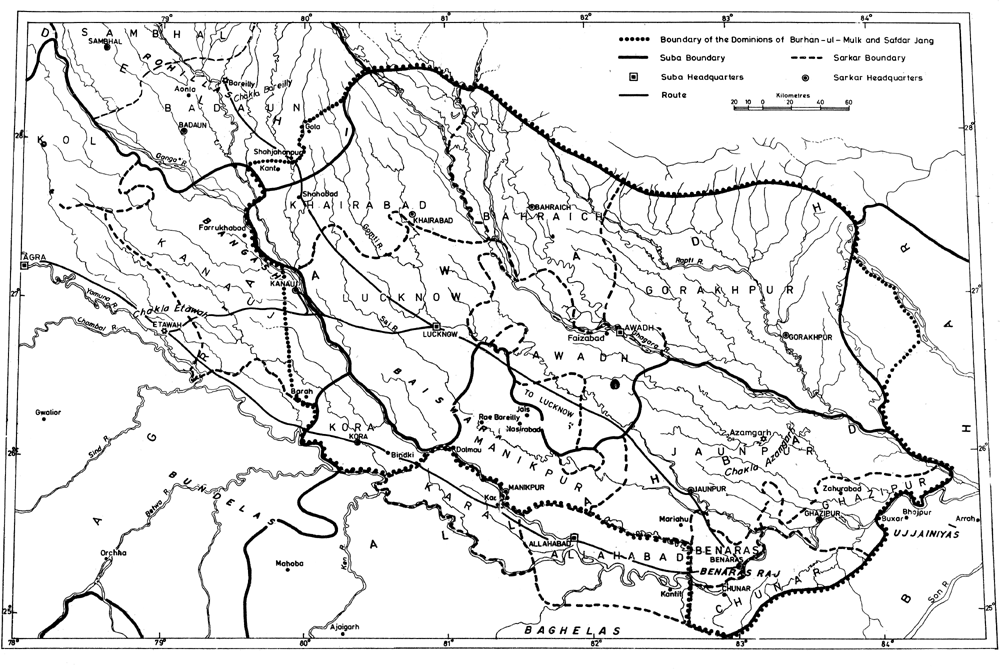
term jagir in the area,34 Burhan-ul- Mulk was apprehensive of his efforts at building a base in Allahabad. Muhammad Khan’s links with Awadh through the Afghans of Shahabad also posed a threat to Burhan-ul-Mulk’s position.35 Again, the disaffected elements of Awadh were often encouraged by him to foment trouble against Burhan-ul-Mulk.36 7. Territories under Burhan-ul-Mulk and Burhan-ul-Mulk thus not only Safdar Jang had to remove him from the governorship of Allahabad; he also wanted to weaken him to prevent him from ever challenging his authority in the region. With this in view, Burhan-ul-Mulk did not even hesitate to help the Bundelas who often plundered Muhammad Khan’s jagirs and constantly threatened his authority in Allahabad.37 In 1727–8, Burhan-ul-Mulk offered to intercede with the emperor on behalf of the Bundela chief.38 And when Muhammad Khan sent his son, Qaim Khan to him to plead his case at Faizabad, the governor of Awadh instead of extending him help, plotted to capture and imprison him. Since Muhammad Khan had the wazir’s support, Burhan-ul-Mulk patched up his differences with Samsam-ud- Daulah who, in turn, assisted him greatly in discrediting the Bangash chief at the court.39
Page 10 of 52
288The Imperial Court, the New Subadars and the Region
(p.261) With these acts Burhan-ul-Mulk not only intended to weaken the Bangash chief but also tried to win the friendship of the Bundelas as also of Samsam-ud-Daulah at the court. The Bundelas now in alliance with the Marathas were ambitious and powerful and the borders of Awadh were not beyond their reach. Since the Bundelas were allied with Samsam-ud-Daulah, Burhan-ul-Mulk appreciated the special value of his friendship. Also, the governor of Awadh had to ally himself with the group of either the wazir or the mir bakshi, as the province was still a part of the Delhi-based empire. Burhan-ul-Mulk had come to Awadh in the face of an imperial order transferring him to Malwa. He thus had to establish the legitimacy of his possession of the province. Between the wazir and the mir bakshi, Samsam-ud-Daulah, the latter was the unavoidable choice for Burhan-ul-Mulk at this stage. His ambition of governorship with additional power and independence was in agreement with Samsam-ud-Daulah’s ideas of a new imperial framework. Further, their common hatred for Muhammad Khan Bangash, though for different reasons, also played its part in bringing them together.40
It also seems that Samsam-ud-Daulah had lately begun to exercise considerable influence on provincial matters. It is well known that he had full control over the affairs of Kabul and that the governor of Bengal was his friend. In 1730 under his influence the emperor replaced Sarbuland Khan by Abhai Singh in Gujarat. On the other hand, Samsam-ud-Daulah also had his own axe to grind in his reconciliation with Burhan-ul-Mulk. Samsam-ud-Daulah had a jagir in Awadh,41 and perhaps feared that the governor of Awadh, on the plea of making reforms in jagir administration, could withhold the revenues of the jagir.
Thus, it was his interest in the province which governed the new subadar’s political alignments with the emerging power groups in the (p.262) region as well as with the central authorities. Subsequently sometime towards the beginning of 1730 or the end of 172942 Burhan-ul-Mulk’s fourth visit to Delhi marked his re-entry into the arena of court politics.
Soon after, Sarbuland Khan, a friend of Burhan-ul-Mulk, became the governor of Allahabad while Safdar Jang was appointed faujdar of four important eastern sarkars of the province, namely, Jaunpur, Ghazipur, Chunar and Benaras.43 Since Muhammad Khan also had interests in the region, he still tried to regain the province. Eventually he obtained the faujdari of Kora which was close and to the east of his hometown, Farrukhabad and also provided a base for his operations to defend his jagirs towards the south in Bundelkhand. He managed to secure this important western sarkar of Allahabad under the pretext of chastising, and securing the revenues of the jagir of the wazir from, Bhagwant Udaru,44 (p.263) a powerful ‘recalcitrant’ Zamindar. But the rebel could not be subdued until Burhan-ul-Mulk was given the charge of the sarkar.45
Page 11 of 52
289The Imperial Court, the New Subadars and the Region
To promote and strengthen his position as governor of Awadh, Burhan-ul-Mulk extended his authority to a large chunk of Allahabad in a manner which amounted to a virtual seizure of these sarkars.46 A demonstration of military power he believed would be an effective device in preventing his possession or part of it from falling into the hands of others. Later in 1736, Burhan-ul-Mulk on presenting a peshkash of Rs 15,00,000 obtained the governorship of Allahabad.47
A crucial factor which led to the control by the governor of Awadh of these sarkars and eventually the entire province of Allahabad was the fairly widespread disturbance in the region. The road from Bengal to Delhi which passed through Benaras, Allahabad, Kora Jahanabad, Bindki and Etawah, and was used to carry the Bengal treasury to the capital, for example, had long been disturbed. According to a mid-eighteenth century chronicler of Allahabad, the zamindars of the eastern sarkars of the province, namely, Jaunpur, Ghazipur, Chunar and Benaras had refused to pay the revenue and taken to plunder and highway robbery. ‘Some of the zamindars, e.g. Rajputs of pargana Keswar in Benaras’, he added, ‘had acquired so much power and influence that they dislodged the imperial officials in Benaras and had the audacity to think in terms of building up their own independent territory (wilayat) in the region’.48 The chronicler’s statement is amply illustrated from a large number of akhbarat bearing on the zamindar revolts in the region.49 In the intervening period there were some attempts to make (p.264) an arrangement with recalcitrant zamindars,50 but to no avail. On the contrary, the disaffected officials who suffered due to the arrangement became a source of trouble to the imperial administration.51
Early in Muhammad Shah’s reign, a large part of the region comprising of the sarkars of Jaunpur, Ghazipur, Chunar and Benaras, was taken over in ijara by Mir Rustan Ali Khan. Mir Rustam engaged Mansa Ram to collect the revenue. Later, Mansa Ram founded the Benaras raj.52
The antecedents of the revolt of Bhagwant Udaru in sarkar Kora can be conjectured. Beyond Kora, the road partly lay in the province of Agra where the Jats successfully challenged Mughal power. As early as 1714, the waqai‘nawis of chakla Etawah reported no less than five incidents of zamindar revolts in and around the chakla. The ri‘aya of pargana Shikohabad were reported to have abandoned cultivation and fled away, while Debi, a refractory zamindar would have occupied the fort of Shahabad but for the timely intervention of Raja Gaj Singh. Babar Afghan, a resident of Rashidabad alias Sioli who had been given a sanad for khidmat in the parganas of Siohar, Karauli and Patiali was reported to have turned defiant.53
Page 12 of 52