42Once the limit is determined, anyone ambiguous about it still has to comply with the limit. Or exit. Move to Montana or Manila.
In other words, one way to remove goal ambiguity is through organizations’ efforts to align the goals of its members, through voluntary commitments during formation, and thereafter through incentives and enforcement. Furthermore, multiple goals embodying differing tastes, preferences, and values can be leveraged and achieved through organizations aligned with these. For unaligned individuals, the choice then becomes unwilling compliance or exit. This works in the case of organizations and markets. But it can be problematic or even impossible in the case of states.
2.3
Problem Dimension Three: Isotropy
The third dimension of the effectual problem space, isotropy, differs from Knightian uncertainty and goal ambiguity. Isotropy refers to the problem of relevant vs. irrelevant information. In contexts of reasonable predictability, it is relatively easy to evaluate the relevance of any given piece of information. But contexts of innovation are contexts of unpredictability. And in these, even when goals are clear, the isotropy problem is rampant. In fact, the more innovation called for, the more this problem might become salient to all kinds of endeavors, including the enterprise of policymaking. Decisions and actions for the fabrication of organizations involve isotropy. Even more so the making of markets and the shaping of states. And most importantly, isotropy pervades choices between markets and hierarchies. In order to clarify the concept of isotropy a bit more extensively, let us consider a standard problem that budding entrepreneurs face.
43An Effectual Analysis of Markets and States
Suppose you have come up with the idea for a green widget. Most standard textbooks and courses in entrepreneurship would suggest you go talk to potential customers and ask for their input in making marketing and production decisions. This advice is based on conventional wisdom that makes a series of assumptions, each of which is usually not only unjustified, but has the potential to misguide entrepreneurial action: • There exists a market for the product. • You know who your potential customers are likely to be. • Your potential customers know what they want. • They will actually do what they say—buy what they say they will buy, not buy
things they say they will not buy, etc. Note that these two are not the same, nor are
they symmetrical. • You have the time and resources to talk to enough potential customers to figure
out what they want and do not want. • Your potential customers will not want completely contradictory features. • There are no customers you do not know about.
You can combine the above into the most important and fatal assumption of all: Markets are out there, in an objective sense, and they can give you reliable, actionable answers. This implies that markets are not themselves artifacts of what you and others do. In other words, markets are mostly exogenous to human action, not endogenously created through it. Not only entrepreneurs, but large established companies who can afford the best market research techniques and talents available, routinely make two bad bets based on these assumptions: 1. They make decisions assuming markets are more predictable than they are. 2. They miss out on making markets that could be made without resorting to
prediction. Effectual entrepreneurs choose to make the opposite set of bets, choosing to make the opposite error on predictability. They treat markets as artifacts and approach them as less predictable than they might be. Let us now consider how that enables them to overcome the isotropy problem. How the Crazy Quilt Principle Helps Overcome Isotropy. If you approach markets as exogenous, but predictable, and you ask for information, advice, and feedback from potential customers, one of the interesting problems that arises is not that you do not get enough information, but that you get too much information. Too much in the sense that the information confuses, rather than clarifies, your understanding of the situation. If you now take seriously the idea that there may be other customer segments out there that you may not have predicted and widen the circle for your research, the isotropy problem of too much and too varied information without clear criteria to distinguish relevance only increases in quantity and intensity. No brainer as it may be, seeking more information does not usually reduce isotropy.
44S. D. Sarasvathy
Expanding cycle of co-created resources
New
Means
Who I/WE are
Interact
Effectual
What can
What I/WE know
with
stakeholder
I/WE do?
Pilot in the plane
Whom I/WE know
other people
commitments
Affordable Loss
Crazy Quilt
Bird in hand
New
Goals
Converging cycle of co-created contraints
Surprise!
Lemonade
NEW MARKETS
Fig. 1 The Effectual Process. Note: Author’s creation
The only way to overcome isotropy is to ask for actual commitments, not merely information, advice, or feedback. In other words, market mechanisms such as deal terms, real investments of financial and nonfinancial resources, preselling, etc., are examples of ways to overcome isotropy. When someone says they will or will not buy something at a price, that is predictive information of little or no value to effectual entrepreneurs. But if someone underwrites the next step in the venture, by actually producing a prototype for you, or by introducing you to someone who can do a trial run without charging you up front, or signs a preorder that allows you to set up favorable terms with vendors, etc., then the next step is not a speculative bet. Instead it is an actionable task you can accomplish for affordable loss.
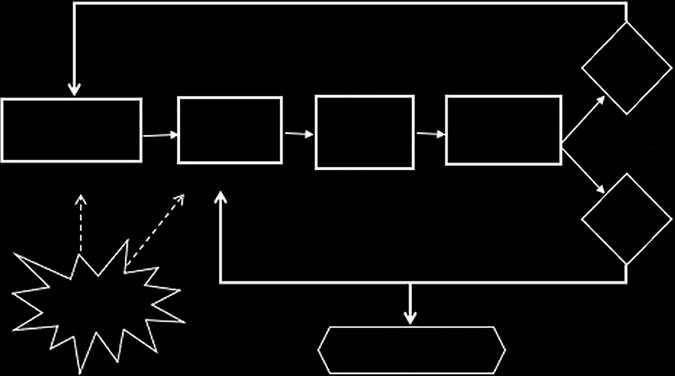
By stitching together a series of such actual commitments (See Fig. 1 for a graphic illustration of this process), effectuators end up cocreating a market that neither entrepreneurs nor anyone else might have predicted. Hence markets themselves become an artifact of the effectual process. In this sense, as Schumpeter argued, entrepreneurship is more about cocreating new markets than innovative products and ventures within extant markets.
Relevant information in the effectual process therefore gets its relevance from individuals and/or organizational actors who, for idiosyncratic reasons of their own, enable you to accomplish key venture-building actions for affordable loss. These individuals or organizational actors self-select into the process—an act characteristic of markets, not states. Yet the deal terms of each effectual commitment entail elements of governance, constraints on future actions, and future interactions with future self-selected stakeholders that become the building blocks of the hierarchy that comes to be as well. In other words, the effectual process offers the quintessential microprocess of mixing and matching market-like and state-like elements that An Effectual Analysis of Markets and States
45add up to actual new markets and new organizations that come to populate economies and societies. Ergo, it is worthwhile to take a bottom-up view of markets and states through an effectual lens.
3
Markets in Effectuation
It is worth explicitly acknowledging that I am assuming a world in which individuals are relatively free to act effectually, as in modern democracies in which there exist reasonable avenues for entry and exit into labor markets, different types of private and public organizations, and even some movement in and out of states. At least a minimal level of property rights and contract enforcement are also the norm in this analysis. Of course, this is not readily true for a large portion of humanity. But for the purposes of this analysis, I assume a minimal level of existing norms and institutions of individual freedom. Is the existence of relatively free markets necessary for effectuation? Yes and no. Without belaboring the point, remember that effectuation is a method of shaping and cocreating institutions and environments, including institutions of freedom. However, an analysis of how effectuation can work under varying degrees of tyranny or coercive oppression is beyond the scope of this essay.
The Hayekian notion of variation in and across individuals, whether in the form of preferences and values, or experiences and situations that disperse knowledge and ignorance in totally unpredictable ways throughout society makes effectuation more efficacious. This is not surprising since effectual action is the micro-foundational prior to market transactions. The effectual process coheres well with the idea of markets as games without goods (Buchanan and Vanberg, 1991). The role of markets, from an effectual perspective, is not to optimize resource allocation, but to allow productive innovation to happen. In this sense, effectuation endorses a view of markets as (co)creative processes rather than allocative or discovery processes.
But the effectual process, as depicted in Fig. 1, also provides the microfoundations for the cocreation of organizations and institutions, not only products and markets. In other words, every effectual commitment from two or more entities, entrepreneurs and their stakeholders, results in shaping governance mechanisms related to the commitment. Each commitment also makes particular futures more predictable, as goals converge toward clarity while reducing isotropy. In other words, as the effectual process fabricates longer standing relationships and governance mechanisms, a more causal/predictive approach becomes feasible and even necessary in some cases. This implies that you can design, create, and set up governance mechanisms effectually, but once set up, it is far more difficult for them to operate effectually. This is a case of effectuation leveraging market processes to