49An Effectual Analysis of Markets and States
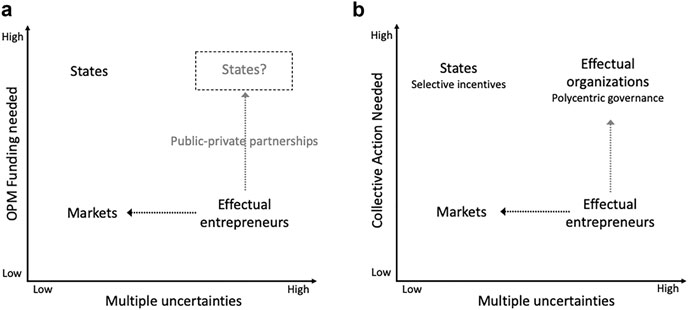
Fig. 2 a, b The role of markets and states in innovation. Note: Author’s creation
requiring more than funding, such as those involving collective action even before funding becomes salient. These are usually dubbed situations of market failure. I will, however, eschew that term since it sets up an overly rigid dichotomy between markets and states and completely obscures the role of effectual entrepreneurs in building and reshaping both. Figure 2a captures the argument that both markets and states will find it difficult to tackle the effectual problem space. Without restricting effectuation to individual actors, it is still easy to see why idiosyncratic individuals may be more likely to kick off the effectual process, even though the process almost immediately moves to more than one cocreative stakeholder, hence not an individual-level phenomenon at all. The point here is not about whether only individuals can effectuate. Rather it is to highlight the idea that something other than prediction-based reasoning is needed and used on the right-hand side of both Fig. 2a and b. In other words, waiting for consensus based on reasons and projections is not a necessary condition for effectual action leading to the cocreation of new markets. Means-driven possibilities within affordable loss are sufficient. Once kicked off, the effectual process can stitch together several different kinds of partnerships, including public-private partnerships that can eventually lead to a larger role for states in funding isotropic possibilities whose promise might be more easily folded into politically palatable predictive approaches. In sum, when funding requirements are very large, states will have a larger role to play even though they may need to be cajoled into it through effectual action. SpaceX and other companies collaborating with state space agencies are cases in point.
Figure 2b addresses situations requiring collective action, such as those involving common pool resources or persistent inequities often ignored by those with power and privilege. In such cases, effectual entrepreneurship is even more crucial in the face of isotropic possibilities under Knightian uncertainty. In a recent study, we reanalyzed the data Elinor Ostrom had collected on how a variety of different stakeholders came together to cocreate polycentric governance mechanisms for the S. D. Sarasvathy
50administration of the water basins in the Los Angeles area (Sarasvathy and Ramesh, 2019). The reanalysis allowed us to spell out the effectual process that constituted its behavioral microfoundations. Studies have examined effectual action in other settings requiring collective action such as art movements (Callander, 2019; Olive- Tomas and Harmeling, 2020), disaster relief (Nelson and Lima, 2020), and communal well-being in first nations such as the Toquaht (Murphy, Danis, and Mack, 2020). The literature on collective action argues for the need for selective incentives to induce individuals to contribute to the common good (Olson, 1965). In more predictable situations in which the path to societal goods might be clear even if the problem of selective incentives is large, states can provide those. Incentives provided to those reluctant to get vaccinated for Covid-19 are a case in point. However, when the situation contains isotropic possibilities in the face of Knightian uncertainty, effectual entrepreneurs have to kickstart the collective action process and even carry it forward for long periods of time before the environment gets reshaped enough to engender the political will needed. The years of Don’t ask, don’t tell even when presidents in office were morally supportive of gay rights are a case in point here.
5.1
Applying the Framework to Innovation Policy
A word on applying effectual approaches to innovation policy. While the development of scientific institutions such as universities, peer-reviewed journals, R&D departments, and national innovation funding agencies such as the National Science Foundation (NSF) attest to the importance of both public and private organizations,