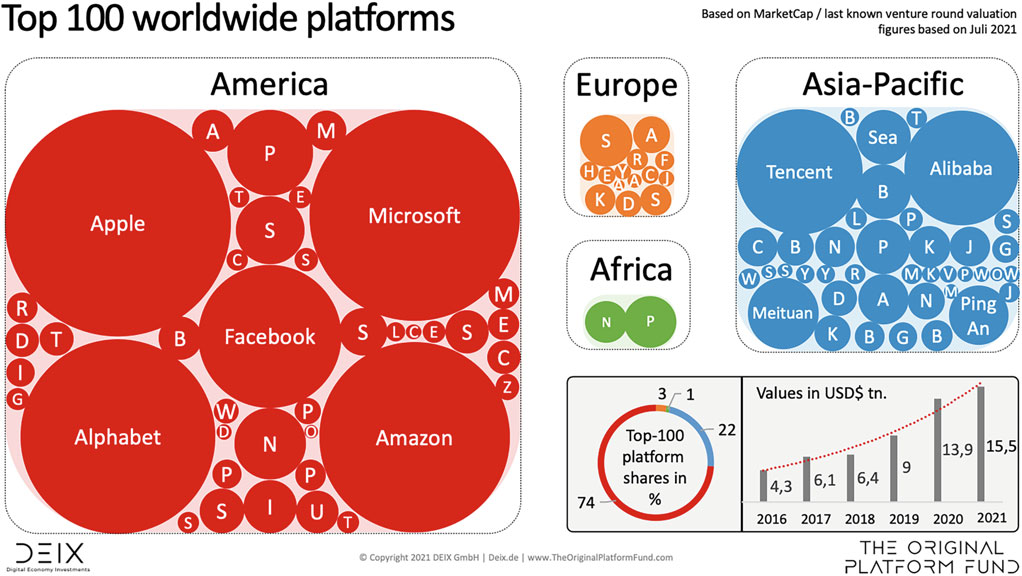
339What has been the outcome of E.U. policy in limiting entrepreneurial activity over recent decades? It is immediately clear from Fig. 3 that the United States and China dominate the platform landscape. Based on the market value of top companies, the United States alone represents 66% of the world’s platform economy with 41 of the top 100 companies. European platform-based companies play a marginal role, with only 3% of market value. Moreover, the distribution of the top 100 platform-based companies is uneven; the first 15 companies represent around 75% of the entire market value. Of the 12 European platform-based companies, one is Norwegian, one Russian, two Dutch, two Swedish, three German, and three are in the United Kingdom. Just comparing platform-based ranking to the DPE Index ranking, the United Kingdom, the Netherlands, Sweden, and Norway are in the top ten, while Germany is 14th and Russia is 48th. It is immediately clear that a strong digital platform-based ecosystem alone is not enough to nurture multi-billion–dollar platform-based companies. Country size also seems to matter. The United Kingdom has now left the European Union, which has reduced the number of top platform-based companies in the European Union to nine, with only SAP among the top 15. Perhaps a more unified European Union will provide a more favorable environment for platformbased development.
5
Conclusion
In the hierarchical world of the twentieth century, giant firms and the state needed and relied on each other, especially after World War Two (Carter, 2020). The state needed corporations to create a growing and successful economy and corporations needed the state for market stability: labor markets, capital markets, financial markets, foreign exchange markets, and international markets. Both governments and corporations relied on hierarchical order. In this world, as Ferguson (2018)
15Also see Karlson et al. (2019).
340Z. J. Acs
Fig. 3 The Top 100 Platform Companies around the World (July, 2021). Source: https://www.netzoekonom.de/plattform-oekonomie/Reprinted with
permission The Digital Platform Economy and the Entrepreneurial State: A European Dilemma
341makes clear, “The tower represents hierarchy and the crucial incentive that favored hierarchical order was that it made the exercise of power more efficient.” The symbiotic relationship between market and state is the greatest distinction between one government and another: the extent to which government replaces markets or markets replace government is not an either–or.
What has happened in the twenty-first century, according to Ferguson (2018) and others is that with the re-emergence of networks, the balance between state and market has shifted as hierarchy has been replaced with networks. The state has maintained its bureaucracy, but with little or nothing to manage, as networks are less concerned with power than hierarchies. This also explains why in the United States, the European Union, and China, the political establishment clings to power while society has mostly dismantled hierarchy in the private sector and the majority of the electorate is deeply alienated from the political establishment. The struggle is therefore now over liberty, with state and society in conflict over how to tame the despotic leviathan (Acemoglu & Robinson, 2019).16